The Mandalorian’s second season in many ways is a step forwards; it maintains its unique space-western atmosphere whilst broadening its cultural inspirations in its storytelling, and delivers a strong emotional throughline for its characters with an incredibly satisfying conclusion. However, it also feels like a step back in some regards – its disjointed serial format makes the lack of a strong overarching plot very apparent, while betraying its premise with an abundance of cameos, crossovers and callbacks that, while handled relatively well, bury its original story under the trappings of the wider Star Wars universe.

I wasn’t entirely sure what to expect from Star Wars‘ first big budget, live action TV series, but last year’s premiere season of The Mandalorian was a breath of fresh air for the struggling franchise; offering a Western-inspired atmosphere and manner of storytelling, as well as being distinctly removed from the events and characters of the Skywalker Saga, it was a wholly unique experience for fans, and certainly felt like a step in the right direction for me (you can read my Season 1 review here!). Naturally, I both expected and eagerly awaited a second season, and less than a year later it’s made its debut on the Disney Plus streaming service – thankfully now available in the UK.
Spoilers ahead!
Much like its predecessor, The Mandalorian Season Two offers eight episodes centred on its titular bounty hunter, Din Djarin (Pedro Pascal), who following on from the end of the last season has been tasked by his clan leader with delivering his mysterious, Force-wielding companion, The Child, to the Jedi Order. Given this takes place not long after Episode VI, Jedi are obviously few and far between, so he begins the season seeking out other Mandalorians around the galaxy that might help him on his journey. Similarly to Season One, each episode is more or less a self-contained adventure that only incrementally advances the season’s overarching story, but where the first season got away with it thanks to a somewhat nebulous throughline of “Mando going on the run to protect The Child”, the show’s central narrative now feels frustratingly obstructed with Mando getting wrapped up in other people’s problems week after week like some sort of videogame character taking on every side quest they can find, while any serious plot development is sprinkled out as conservatively as possible for the bulk of the season.

Nevertheless, things pick up a little bit with the last three episodes, as the villainous Moff Gideon (Gianarlo Esposito) returns, kidnapping The Child and leaving Mando to set up and execute a daring rescue with the allies he has accrued across this season and the last, but even then they’re posited as three individual subplots as opposed to a true three-part finale. Many of the episodes continue to use those inherently Western-inspired story outlines for their plots, but The Mandalorian begins to branch out into other realms of storytelling, with certain episodes taking inspiration from the likes of pirate or samurai adventures, yet still managing to remain in keeping with the tone and feel of the show as a whole. It also follows on pretty nicely from the last season in terms of how Mando’s actions and the events of those episodes are now coming around with positive and negative consequences, making it an effective continuation of the story. Still, one critical oversight is the fact that Mando, the bounty hunter, doesn’t actually do any bounty hunting this season, and you can hardly say it’s because he’s too preoccupied with his mission – and I think its that lack of narrative focus that really harms Season Two’s plot, despite the writing being adequate at the very least in every other regard.
One thing you’ll certainly notice about the story in this season of The Mandalorian is that it really fucking loves cameos – to the point where over half of the episodes are built around a character from some other Star Wars property. Between Cobb Vanth, Boba Fett, Bo-Katan Kryze, Ahsoka Tano, and even Luke Skywalker himself, it’s hard not to notice that Season Two is a far cry from its predecessor in terms of feeling like a self-contained original story, and I for one certainly felt that Lucasfilm have far overstepped the mark on this one trying to stuff as many jangling keys into one season of television as possible. They’re still handled relatively well, and there’s a clear attempt to work them into the story organically, even if it does look ludicrously fortunate on paper for Mando to be running into all these key figures in galactic history within the space of like a week. Even the appearance of an uncanny valley CGI Luke Skywalker in the finale proved to be a far more touching use of the character than his Sequel Trilogy counterpart, but the fact remains that the constant barrage of guest stars undercuts the season’s central story and the presence of its original characters, and it certainly eliminates any sense of insulation that the first season had.
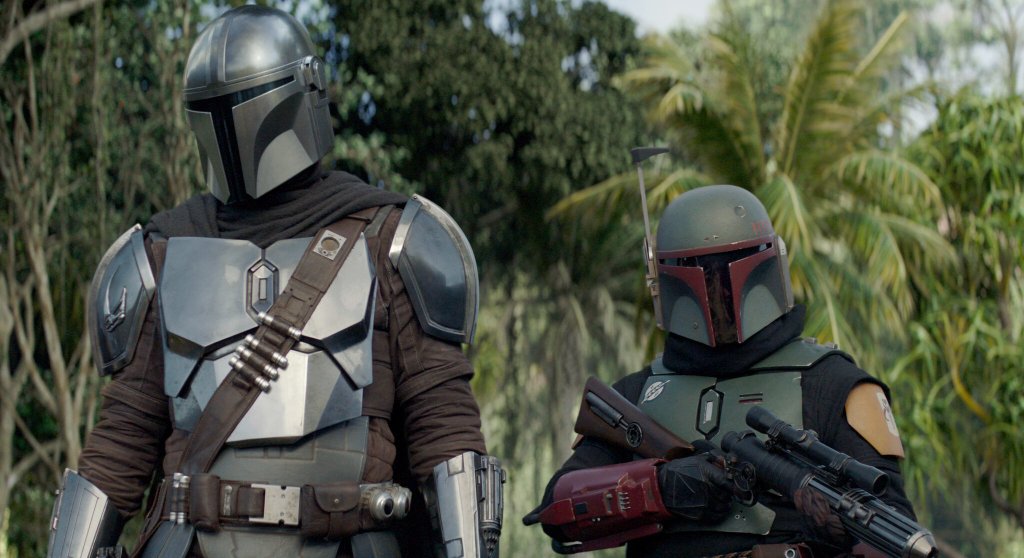
As much as the cameos might overshadow the show’s own characters, they aren’t at all neglected as a result, and Season Two actually provides an extremely satisfying arc for its titular lead. Mando’s relationship with The Child is deepened as he develops a more paternal relationship with the Yoda-like creature beyond simply just acting as his protector, and as well as giving Mando a more human disposition, it also serves as a basis to further bring The Child to life as the two display a more familial nature with each other. Mando’s openness to others, particularly his attachment to The Child, continues to build from Season One, and it culminates in the finale where Mando is faced with the tough prospect of giving away his companion to Luke Skywalker; a devastatingly emotional conclusion to the season that hammers home the weight of the relationship between the two for a brilliant and frankly unexpected goodbye for the little green puppet. The Child feels far more fleshed out in general; now shown to have a basic level of co-operation that gives him more agency and makes him seem like less of a burden attached to Mando’s hip, and although I was certainly left wishing for more in this regard, the season also peels back another layer of the mystery around the character by revealing his name – Grogu.
The Mandalorian Season Two also sees a return for much of its supporting cast, albeit in a more limited capacity than they appeared in the prior season. Carl Weathers’ Greef Karga and Gina Carano’s Cara Dune make a return in Episode 4, now working side-by-side as the High Magistrate and Marshall of Nevarro respectively, which ends up feeling like a nice progression for the both of them, even if it did happen off-screen. Also rejoining the cast, this time as an ally for Mando, is Fennec Shand (Ming-Na Wen), but it’s her newfound travelling companion, Boba Fett (Temuera Morrison), who steals the show thanks to a brilliant portrayal of the ruthless bounty hunter that shows him to be equal parts brutal and honourable; living up to the legacy of the character so many years later. Still, the unexpected highlight of Season Two proves to be Bill Burr’s Migs Mayfeld, making a fantastic return in Episode 7 with Burr giving it his all with a performance that helps cement the character as one of the best the show has delivered in its entirety, even with such little screentime. It can’t go without mentioning that Giancarlo Esposito returns as the gravitational Moff Gideon, now fully embraced as the show’s overarching antagonist, but outside of a solid performance he really lacks any further characterisation, leaving him to be one of the weaker elements of an otherwise solid cast.

I lavished a lot of praise on the first season of The Mandalorian for pushing the boundaries of what a television budget could accomplish in terms of special effects and production design – especially thanks to its groundbreaking Volume soundstage – and Season Two certainly hasn’t dropped the ball on that front; remaining visually enthralling from start to finish. It seems the studio’s confidence in the series has also earned it a little extra pocket money, with Season Two boasting a far more diverse selection of sets and locales, while only increasing their level of detail, which goes a long way in bringing the series to life. Another facet of the production that sees some serious improvement is the fight choreography, offering a higher number of action scenes of a far more impressive quality, with the respective scenes of Boba Fett and Luke Skywalker tearing through Imperials being nothing short of brilliant. Ludwig Göransson continues to impress with his original soundtrack, including some fantastic new themes for this season’s characters, while the story affords him the chance to work in some recurring motifs from elsewhere in Star Wars too. Whatever you make of the rest of it, The Mandalorian undeniably continues to bring an unrivalled cinematic quality to the table that even puts it ahead of a lot of films, let alone rival television series.
When it’s all said and done, I can gladly say that if you enjoyed the first season, The Mandalorian‘s second outing is more than worth your while. Yet, with that said, I also have to say that a crop of new issues do cast a long shadow over the season, and I’ve wavered over where to place it in terms of a rating. Unfortunately for me, that indistinct approach to its story and an overreliance on interconnectivity causes the series to lose a little too much of its charm, even in the face of improvements in its character writing and visuals. Nevertheless, I’m by no means dissuaded by the show, and with a post-credit stinger for an upcoming Boba Fett spinoff at the end of the finale, it seems that The Mandalorian has a steady future ahead.
6/10


 A.J. Slater
Leave a comment