The latest outing of the Caped Crusader is dark, grounded and brutal in all the right ways. It starts strong, but unfortunately becomes bogged down by a bloated plot, dull supporting characters, and a fatal flaw at the heart of Robert Pattinson’s take on the Dark Knight.

I wasn’t exactly sold on The Batman when its existence came into public knowledge – the production had been tumbling through the hands of multiple writers, directors, and even Batmen – as it was originally intended to be a solo story for Ben Affleck’s Dark Knight. Then came the castings, and while I wasn’t opposed to Robert Pattinson in the lead role, I’d never really took him for a serious actor, and the prolific race-swapping of the supporting characters started to signal to me that this was intended to be a Batman for the fragile, metropolitan audiences of today. My estimation of the movie really hit rock bottom when I first laid eyes upon promotional images of Batman’s cheap and goofy looking supersuit, as well as Riddler’s BDSM/Winterwear hybrid getup, and while I still thoroughly dislike the costumes, from there the only way was up. With each successive trailer release, my anticipation began to skyrocket as I came to see the dark, gritty vision that director Matt Reeves had in store for the movie, so by the time the March 4th release came around, I was more than ready for what The Batman had to offer, and while it didn’t quite escape from some of those initial problems I saw, as well as bringing a few more into the final product, it was pretty enjoyable on the back of what it does right.
Spoilers ahead!
The opening of the movie is arguably one of its best points – we follow the viewpoints of three criminals during Halloween night in Gotham City, and as each one sees the Bat-signal lighting up the murky sky, their glee turns to abject fear as the thought of Batman lurking in the shadows takes over. Laid over this is a monologue delivered by the titular character, as he provides us with context for the film as well as a glimpse into the headspace of the clearly troubled hero. The opening clues you into the idea of a more predatory and tactical Batman, but quite honestly, this portrayal of the character is in direct contrast to that notion – he confronts his enemies head on every single time in big, brutal fights, and has no qualms about being caught on film or seen in public by hundreds of different people. It’s clear from the very beginning of the film that it’s trying desperately to frame the idea of vengeance as a key element of Batman’s character, as well as a theme for the entire movie, but there’s very little to show for it. Bruce can be violent, yes, but there’s no passion or anger behind it that speaks to his state of mind as a character, and while I understand that by drawing a parallel between Batman and Riddler, it creates an important catalyst for him to revaluate his motivations, by the end when he has supposedly chosen to wield hope over vengeance, he hasn’t actually undergone any meaningful change, especially when there was no real exploration of what it means beyond a surface level exploration of the character.
That said, Reeves and Pattinson do bring a fresh and unique take to Batman as a character – he’s quiet and reserved, while retaining a strong, commanding presence at every turn, made dually evident by the behaviour of the other characters around him. His moral code is made clear through his actions, but never thrown in your face. He exists at the core of the film, and barring a select few scenes, we essentially see the events of the story exclusively through his eyes, which helps to sell both the unwinding layers of the plot, as well as your investment in his character. Pattinson’s portrayal makes it very clear that Bruce Wayne plays second fiddle to Batman in this character’s life, long before it’s stated explicitly, and the idea of a dark, detached and melancholic Bruce who’s crusade against crime has completely overrun his life was very appealing to me, and it highlights . As much as I dislike it, the suit is clearly designed to look rugged and practical. He carries a range of gadgets, but with the exception of his sci-fi contact lenses, they all remain relatively low-tech – even the staple of Batman using his cape to glide through the night is replaced with a far more realistic sports wingsuit. Unfortunately this is another concept that is seemingly dropped for the sake of spectacle – with all this careful consideration of his kit and skills, the writing for some reason makes him almost entirely resistant to damage from bullets, fire, explosions, falling, and blunt force in one of the most egregious cases of plot armour ever, and when he does take a hit, it never leaves a lasting impact, severely detracting from any sense of stakes in the writing.
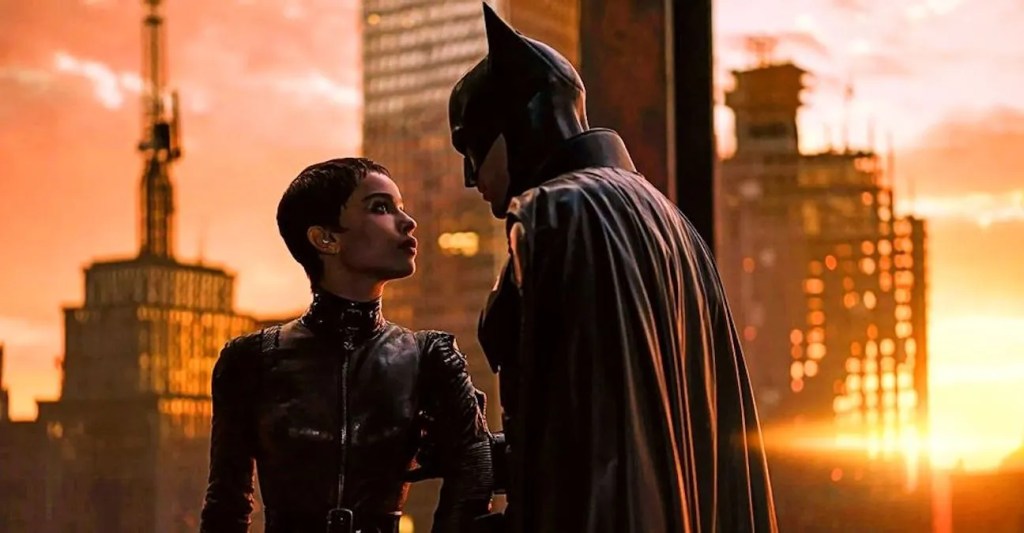
Now, despite the issues, I was more pleased with Pattinson’s Batman than not thanks to the performance and depth of the character. Unfortunately, the same can’t be said for many of the supporting characters. Zoë Kravitz’s Catwoman was billed as more of a co-lead, but ends up being far less involved than expected, and at the risk of sounding like an irate feminist, she comes across more like Batman’s eye candy assistant than anything else. Her motivations are there, but it rarely seems like they exist independently of Batman, and her key character moment feels uncomfortably wedged in between the more important beats of the story. Worse yet, she lacks any of the playfulness, charm or villainy that are central to Catwoman’s character, instead coming across as a very cookie-cutter femme fatale as well as a vehicle for a lovely little slice of out of place racially-charged rhetoric. Speaking of, Batman’s other sidekick comes in the form of not-yet-Commissioner Gordon, played by Jeffrey Wright. He comes across as even more one-dimensional than Catwoman, with very little discernible motivations beyond “catch the bad guys”, and often seems like he exists more for light comic relief and plot convenience than to tell an interesting story – and in a film where corrupt police and city officials are so prominent, they neglect the opportunity to involve Gordon more deeply in those elements of the narrative. He also shows very little in the way of characterisation, and an actor as great as Wright feels a little wasted in the role.
Some of the better supporting characters were Andy Serkis’ Alfred Pennyworth and Colin Farrell’s (yes, that really was him) Oswald Cobblepot, AKA Penguin. Alfred is another iteration of the character in recent years that leans away from the gentleman butler archetype to make him much more involved and useful in Batman’s crime fighting, but I thought it was an interesting take to posit him more at odds with Bruce at first until they gradually reconcile over the course of the film. Unfortunately, this is another element of the plot that gets pushed to the side, so the character feels heavily underused and almost forgotten by the end when he could have been a great avenue to explore that idea of Batman’s vengeance so often touted throughout the film. Penguin ends up in the same boat, and despite his magnetic presence on-screen, he feels neglected until the film gets to a point at which he can be set up for future appearances. However, the worst offending character in this movie was without a doubt Paul Dano’s Riddler. What had been sold through promotional material as a cold, unfeeling and Zodiac-inspired take on the villain, turned out to be rather antithetical to that. Riddler is hyperactive, excitable, and beyond his first scene, wholly unintimidating. The character’s motivations are kind of just glossed over to avoid making him too sympathetic, and it feels like the priority of the writing is to portray him as a caricature of the contemporary “incel” stereotype by spoofing far right online culture rather than a well crafted and engaging character. Dano plays the role well enough, but even he struggles with some of the most ridiculous scenes, namely when Riddler has an exasperated, screaming meltdown in front of Batman, and it just leaves what was one of the biggest draws of the film for me sadly feeling like one of it’s biggest let-downs.
The Batman‘s story is just as much of a mixed bag as its characters. Following the initial scenes of both Batman and Riddler, the film wastes no time in getting underway with its central murder-mystery plotline, which ended up being one of its biggest highlights. It finally feels that the “World’s Greatest Detective” aspect of the Batman character is shown some love, as he takes on his opponent in a far more psychological way than any movie prior to this. However, layered in with this are many, many more moving parts and small storylines embedded in the larger narrative, and while the film does surprisingly well to manage them, resulting in a lot of story beats feeling underutilised and oftentimes forgotten. A friend of mine who watched the film with me made the rather poignant observation that there was easily enough story here for two films, and I have to agree. For example, the third quarter of the film goes full throttle into the criminal conspiracy in Gotham and Catwoman’s own story, so much so that you almost forget that Riddler is even the main villain until his name is brought up again. In general it feels like parts of the plot are dropped in and out entirely just to make room for every idea that Reeves had, resulting in a movie that does feel quite messy overall. Amazingly, it manages not to feel unfocused in spite of this, and the many layers of mystery plus excellent use of suspense keep you thoroughly engaged in the plot no matter what part of the story it shifts into.

What does seem to be a big cost to a film with this many story elements is the abundance of convenience in many of the big developments throughout. The bad guys just happened to keep Catwoman’s friend’s corpse in their car, she just happened to be recording her own murder on voicemail without anybody noticing, the phone that the audio was sent to just happened to not have been destroyed by the criminals that took it – the list goes on, and that’s only in reference to one of the many plotlines. The Riddler mystery plays it a little smarter but even that can’t escape an easy way out at one point, with Batman happening on a police officer who has the exact information he needs to uncover the next clue. I did find myself a little frustrated with how infantile the writing treats the audience, with a lot of out-of-place moments of things being read out or overexplained, which stings all the more in a film that tries to be a little more cerebral than other comic book movies. It’s in the finale however that the level of stupidity hits an all time high. With Catwoman saved, corruption in Gotham rooted out, and Riddler caught, I was fully prepared for the film to come to a close, but wait – a final twist! Riddler has set off bombs to flood the city! How this fits with what we came to understand about his character and motivation up until this point – who knows? That said, the idea of him getting a final one-up on Batman at the end wasn’t a terrible idea, but wait – another final twist! With no meaningful setup whatsoever, Riddler has suddenly amassed a crew of devout incel shooters through his 500-strong follower base online to carry out a mass murder, so it’s up to Batman to save the day. This sequence feels so alien to the rest of the film I can only assume it was put in to add another heavy handed sprinkling of contemporary political messaging to a film that had already overstepped its mandate, and tagged onto an otherwise enjoyable story, it ends up leaving a pretty sour taste in one’s mouth.
Perhaps the only aspect of this film that remains consistently fantastic is in its artistic merit and production values. It excels in creating a persistently rich atmosphere throughout thanks to the stellar cinematography and Michael Giacchino’s haunting soundtrack. To circle back to that fantastic opening, the thunderous march of the latest Batman theme as petty criminals looked up at his insignia above the murky Gotham skyline was a moment of unadulterated brilliance. I’d go as far to argue that The Batman is probably the most stylised and beautiful iteration of the Dark Knight ever put to screen, to a point where it actively raises my appreciation of the film despite many of its writing problems. Visually, Gotham City is brought to life in a way that the past couple of takes on this world seemed to be lacking in, even if it doesn’t quite meet the Nolan movies’ standard when it came to bringing the everyday citizens of Gotham into Batman’s story. Among other details, the technology and writing establishes that it takes place close to the present day, yet retains an otherworldly feel in the sense that it doesn’t entirely resemble the 2020s setting either. Although I’ve made my grievances already known with some of the costumes, the looks of many of the supporting characters fit the world just as well, and I’d just like to take a moment to appreciate how unrecognisable Colin Farrell is made under all of the makeup for Penguin. Overall, it ends up being quite similar to 2019’s Joker both in the darker mood it tries to create, as well as the way that it looks almost lifted from the pages of a comic book.
The comparison to Joker isn’t an uncommon one either, and I think it speaks to the future of the DC brand itself that its big-screen adaptations seem to be better served by going down the darker, more serious road, opposed to trying (and failing) to rival the endless churn of loosely connected, poorly written Marvel flicks. Still, that’s not to say that The Batman was perfect by any stretch of the imagination – failure to properly explore its characters, especially the three foremost players in the story, leaves the film feeling hollow and thematically unrealised, and a lot of the minor issues I had with the plot just seemed to heap up on top of this before the out of place finale landed another major blow against the quality of the writing. Still, despite a wide assortment of problems, I did actually enjoy the film far more than I first anticipated – the initial detective story elements were very engaging, and what it lacked in its script it made up for in shovel-loads of style and atmosphere, so while it wasn’t quite enough to entirely captivate my imagination, I can’t say I disliked it either, and as much as there’s definitely room for improvement, The Batman offers a strong foundation for future outings in Matt Reeves’ vision of the DC Universe.
6/10


 A.J. Slater
Leave a comment