Despite offering a mildly interesting re-examination of one of Star Wars’ biggest villains and a visual quality a cut above its predecessors, Tales of the Jedi offers nothing tangible to either of the two characters that it chose to focus on, and ultimately it feels like a pointless exercise that serves as little more than another avenue for showrunner Dave Filoni to satiate his creative ego through his never-ending drive to include his favourite original creation in as many of his projects as possible.
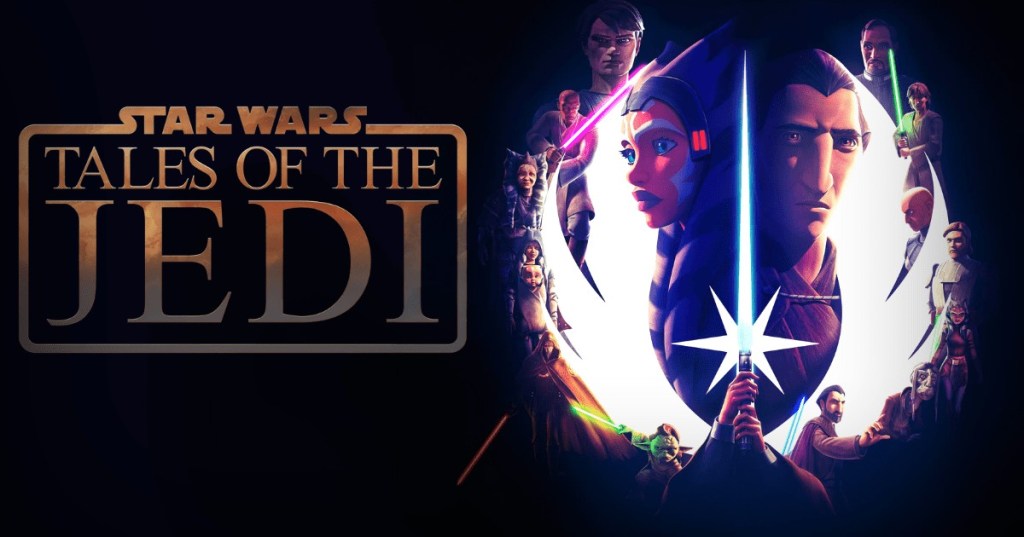
I can hardly say Tales of the Jedi has been my most anticipated Star Wars project this year, but neither can I say that Star Wars elicits much anticipation in me at all off the back of the disastrous Obi-Wan Kenobi series (you can read my review here). Still, I was vaguely intrigued at the promise of an anthology series in the Clone Wars animation style, even if I later discovered that it was less of an actual anthology and more of a duology of character studies split across six episodes. After releasing today, I wasn’t even sure if it would be worth reviewing after coming in at a combined runtime of an hour and a half, but for posterity’s sake, and given I’ve got nothing better to do with my day – I’ll give it a go.
Spoilers ahead!
The season has its focus divided between two characters, and first up is showrunner Dave Filoni’s favourite plaything; Ahsoka Tano. The first episode, Life and Death, is an entirely pointless endeavour that centres on an infant Ahsoka from her birth to the discovery of her Force abilities some months later. The long and short of it is that while on a hunting trip with her mother, Ahsoka is able to dissuade a predator from attacking through the use of her powers, but other than offering a minimal look at the societal structure of her homeworld for the über-lore nerds, it’s an entirely useless and vastly uninteresting fifteen-minute adventure that adds nothing tangible to the character. The same can be said of the next episode to feature Ahsoka, Practice Makes Perfect, which is essentially nothing more than a drawn out training montage that harkens back to the early days of the Clone Wars show. It very blatantly tells you “this is how Ahsoka learned to defend herself from Clone Troopers”, which was a question I guarantee nobody needed answering, while avoiding contributing anything meaningful to the master-apprentice relationship between her and Anakin Skywalker. It’s only the third Ahsoka-centric episode, Resolve, that provides anything remotely interesting for her character – in the wake of Order 66 and the events of The Clone Wars Season Seven, Ahsoka goes into hiding, adamant that her days of fighting are over, but when her Force abilities attract the attention of an Imperial Inquisitor, she is forced to come to the aid of the innocent once again, which leads nicely into her appearance in Star Wars: Rebels as she takes on the mantle of the Rebel spy Fulcrum. It’s a nice self-contained arc for Ahsoka and the only episode featuring the character that actually felt like it was in any way worthwhile, which just goes to show that these days Filoni seems to care more about plastering her across as much Star Wars media as possible as opposed to developing her in any meaningful way.

As for our other character, Tales of the Jedi makes the interesting decision to focus on a younger Count Dooku for its other three episodes, and they’re unquestionably the highlight of the season. The self-contained stories of the first two Dooku episodes are nothing special in and of themselves, but what they do offer is a chartered look at the character’s growing disillusionment with the Republic prior to the events of the Prequel Trilogy. Justice sees a young Dooku and his Padawan Qui-Gon Jinn caught up in the kidnapping of a Senator’s son, but he comes face to face with the corruption of the Senate as it comes to light that the kidnappers are simply the starving constituents of the neglectful Senator. Dooku’s feelings are tempered further in Choices, where the mystery of a murdered Jedi Master takes centre stage. The episode makes the brilliant choice of using Mace Windu as a foil for Dooku, as his sycophantic allegiance to the Republic and the Jedi Council plays incredibly well against Dooku’s ever-increasing frustration with the systems of power, which are made all the more obvious when it is revealed that the deceased Master was killed protecting another corrupt and self-serving Senator. The final Dooku episode, The Sith Lord, takes place concurrently to The Phantom Menace, as the Jedi Master has been long resigned to his discontent with the Jedi Order, and it’s the death of Qui-Gon Jinn at the hands of Darth Maul that pushes him over the edge, and after a confrontation with Jedi Master Yaddle that ends in her death, Dooku solidifies his place as a Sith Apprentice. It’s a solid arc across the three episodes, if not a little bare-bones, but it’s certainly far more interesting than what Tales tries to do with Ahsoka (if it even was trying to do anything), and was undoubtedly the better of the two halves. Nevertheless, as much as that’s true, it’s also worth noting that it doesn’t actually offer anything beyond expanding on inference and lore from elsewhere in Star Wars.
With that, in spite of enjoying much of what it had to offer, by the time it was all said and done I couldn’t help feeling like the hour and a half I’d taken out of my day to watch Tales of the Jedi was time I would never get back. As much the majority of the episodes might offer an interesting perspective on its main characters, the show only regurgitates that which we already know about them from elsewhere in Star Wars media. Crisp visuals do make it feel like another step forward for the Clone Wars animation style, even compared to the likes of The Bad Batch, but without anything of real substance to it, Tales of the Jedi is sadly consigned to being nothing more than a footnote in Star Wars history.
4/10


 A.J. Slater
Leave a comment