
For the uninitiated, Damien Chazelle’s 2014 masterpiece Whiplash follows a young jazz drummer, Andrew Neiman (Miles Teller), and his tutelage under the aggressively perfectionist Terence Fletcher (J.K. Simmons) at the fictional Shaffer Conservatory. Naturally, the plot is built on the relationship between the two characters and their ostensibly intertwined goals. To boil these characters down to their fundamental motivations, Andrew wants to be “one of the greats”; a musician at the height of their talent, whereas Fletcher wants to be the one that brings that about in his students; to push them beyond their limits and inspire true mastery of their art. Put together, Whiplash sees these characters on a self-destructive path to success, and it plays with this dynamic in a very interesting way.
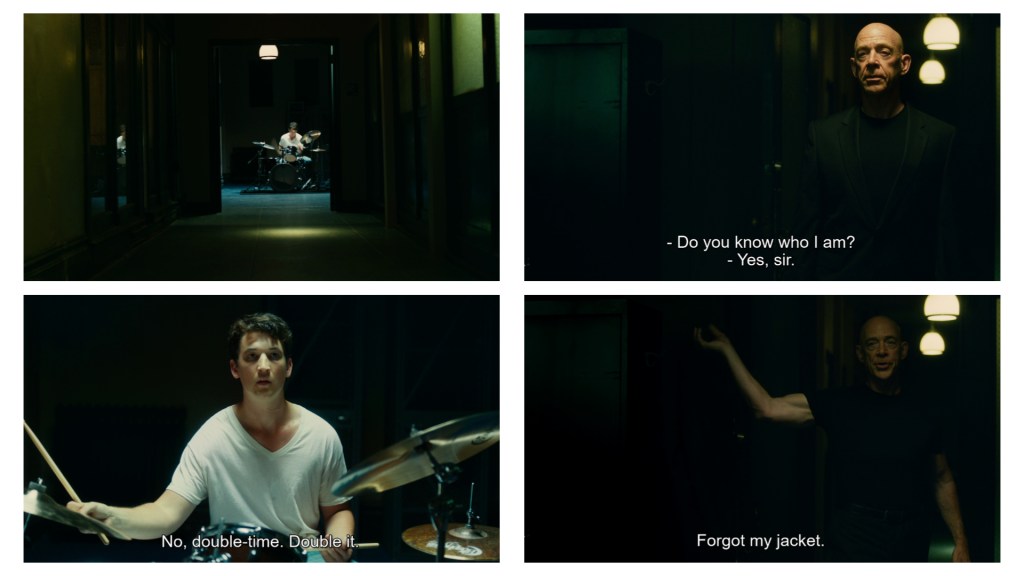
Right from its opening scene, Whiplash establishes that Fletcher’s designs on Andrew are not exactly well-intentioned. In fact, the opening shot of the film tracks closer and closer to Andrew along a dark corridor as he sits alone practising on the drumkit, and it feels far closer to the kind of iconography used in horror films, invoking the image of a predator creeping up on its prey. Playing into this further, Fletcher steps out from the shadows and immediately begins to test Andrew, both in his musical ability and in his psychological fortitude; leaving the room after asking Andrew to perform a double-time swing, only to return for his jacket in an effort to undermine Andrew’s confidence in his abilities, ultimately encouraging him to practise more.

Fletcher’s abusive nature persists throughout the film; especially in how he uses mind games to test Andrew’s resilience and push him to work harder. Upon inviting Andrew to join his studio band, Fletcher purposely misguides him into turning up three hours early, and in rushing to get there, Andrew ends up hurting himself falling down some stairs. In fact, Andrew continuously injures himself throughout the story at Fletcher’s behest, and many times under unnecessary circumstances, suggesting that even in spite of his own goals, Fletcher enjoys his position of power above others. When he eventually arrives, Fletcher approaches Andrew in an uncharacteristically amicable way and questions him on his background, which he later weaponises to humiliate Andrew in front of the other members of the band, again to diminish his self-worth and pressure him into working harder.

A common observation made upon Whiplash is that it closely follows conventions of the sports movie genre, and I’m inclined to agree. Seán Crosson names “the familiar final big game or athletic contest” as one of the genre’s defining tropes (Sport and Film, 2013, pg.12), which certainly draws parallels with Whiplash‘s finale, as Andrew takes to the stage to overcome Fletcher’s abuse and perform a rendition of Caravan for an esteemed audience. The film consistently embraces the physicality of drumming, and we’re shown quite literally the blood sweat and tears spilled by Andrew throughout. One poignant example is the scene where Fletcher puts his three potential drummers through an arduous, hours-long trial to play a perfect double-time swing, by the end of which all of them are exhausted, bleeding from the hands and dripping with sweat. Through the performances of Teller and Simmons, we start to recognise the relationship between Andrew and Fletcher as one akin to a coach and athlete more than simply student and teacher.

Much of Whiplash presents the audience with a very particular narrative about the relationship between its main characters – Fletcher as a cold, authoritarian abuser, and Andrew as a meek, powerless victim – but certain elements of the story suggest this isn’t quite the case, particularly through the framing of Andrew’s relationship with his father Jim (Paul Reiser). An early scene in the film has Andrew imply that he had been vying for Fletcher’s attention for a while, and that his solitary rehearsal in the first scene may have been in an effort to do so – a plan his father seems aware of. This comes full circle at the end as Jim looks on at his son’s gruelling five minute-long drum solo, and we come to realise that despite the ceaseless tirade of abuse on Fletcher’s part, Andrew’s dedication is equally strong, and the two have reached a sort of symbiosis in the final moments of the story as they simultaneously achieve their respective goals.
Ultimately, Whiplash creates a very unique dynamic between its two main characters. It takes the traditional relationship between student and teacher, layers in the physicality of the sports genre, the polarisation of Fletcher’s abuse, and the underlying hints of Andrew’s character to formulate the dichotomy that makes the film so engaging.



 A.J. Slater
Leave a comment