A love letter to all things artistic, this Renaissance based murder mystery is equal parts delightful and unique thanks to a masterful level of talent in its writing and design. Although its simplistic dialogue-based gameplay might not be for everyone, Pentiment continually elevates itself beyond other games in the interactive fiction genre, making it one of this year’s most endearing surprises.
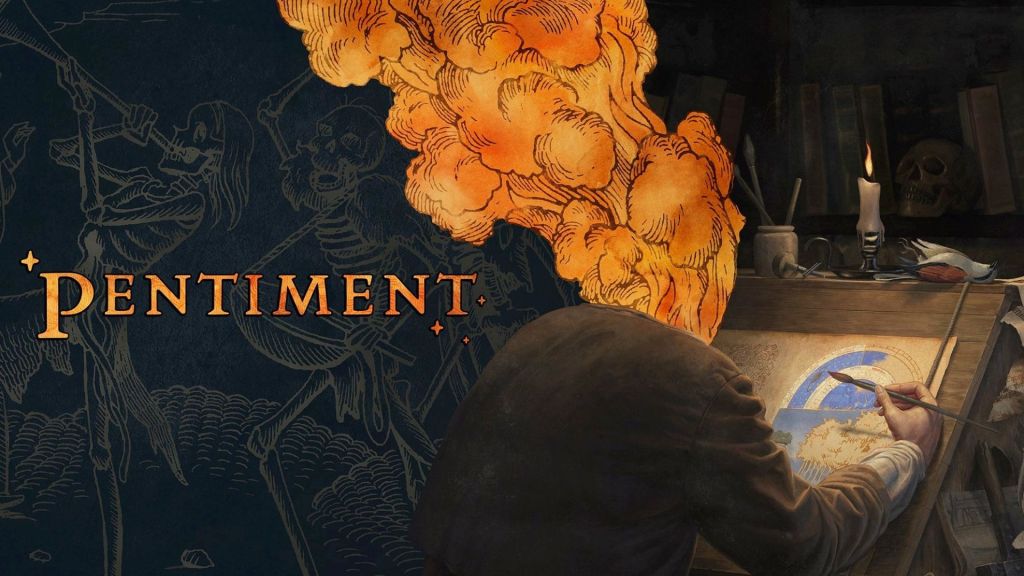
As much as I love a good story, I can’t say I’ve ever been a fan of interactive fiction videogames; preferring some actual gameplay with my games, not just the heavy lifting for a story that more often than not fails to impress. That said, a few exceptions have come my way over the years, namely Telltale Games titles like The Wolf Among Us and their Batman series, so I’m not exactly at staunch odds with the genre, but I hardly gravitate towards it either. Pentiment happened to come up on my radar after this year’s Xbox and Bethesda Games Showcase, with an announcement trailer showing off the game’s unique visual style and promising a dramatic narrative experience from the mind of Obsidian’s Josh Sawyer (the man behind the beloved Fallout: New Vegas), but that’s still not to say I was chomping at the bit to play it. However, given that it released at a refreshingly low price, I decided to take a chance on it, and God knows I don’t regret it one bit.
Spoilers ahead!
With its story divided into three parts, Pentiment‘s first act places you in the shoes of a young journeyman artist from Nuremberg named Andreas Maler, who takes up residence in the Alpine village of Tassing, Bavaria whilst he completes a commission for an illuminated manuscript at the nearby Kiersau Abbey at the height of the Renaissance. The opening couple hours of the game set the scene excellently; introducing you to the location and its many characters whilst delivering the essential historical knowledge in a concise an organic fashion – all the while providing essential insight into Andreas as a character that doesn’t detract from the choices the player makes through the game’s roleplaying elements. When the murder of a visiting nobleman rocks the community of Tassing and Kiersau, Andreas is tasked with uncovering the truth so that he might spare the life of his friend and colleague at the Abbey’s scriptorium, the elderly Brother Piero, who has been falsely accused of the killing. You’re given a number of leads to follow up on with regards to the killer’s true identity with a strict timeline to do so, and you soon discover that many around the village and Abbey had both the motive and means to kill the Baron, and the beginnings of a conspiracy take root as many of the suspects were egged on to commit the murder by a series of mysterious notes. Act I is undoubtedly the peak of the game; drawing you in with excellent dialogue, bountiful historical knowledge and engaging characters, but it gives its best through a deep thematic undercurrent that offers moving and insightful meditations of the nature of art and storytelling that beyond talking at you also encourage you to consider your own views on the questions it asks. While it’s clear the game makes some not-so-subtle strides to remain in line with certain modern-day attitudes, it also feels refreshingly beholden to the story it’s trying to tell, particularly in the restraint it shows in its depictions of Christianity, which for an industry I assumed had been swarmed by Reddit-using, zealously atheist bugmen, came as quite a pleasant surprise.
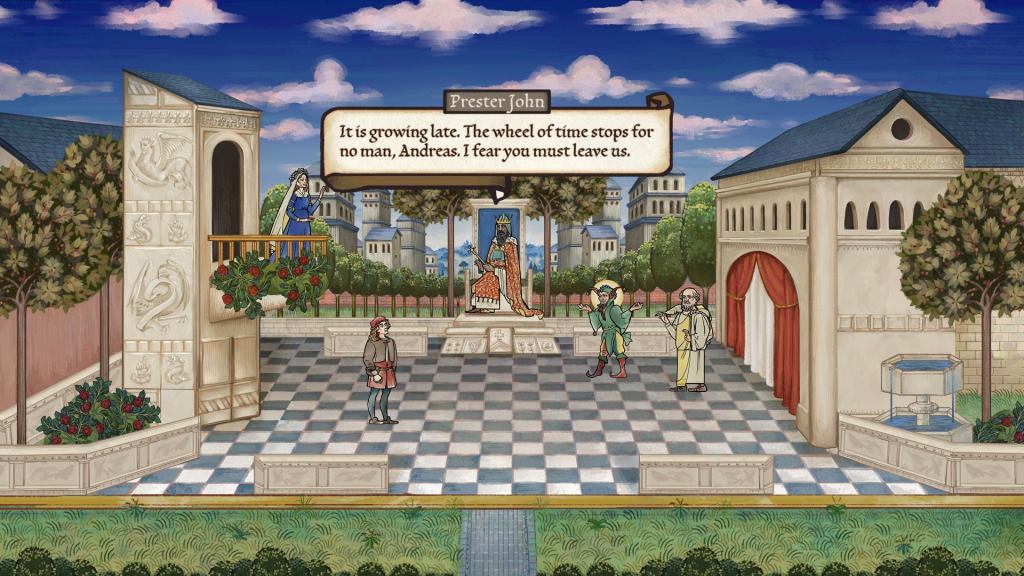
It’s a shame then that Act II seems to suffer from an ostensible decline in quality by comparison, as it sees Andreas, now a successful master artist, return to Kiersau with an apprentice under his wing some seven years later to pay his respects to the now deceased Brother Piero. The second chunk of the game takes on a more solemn tone as it deals with the repercussions of your actions during Act I, with the townspeople at ever increasing odds with the Abbey. When an outspoken voice for the people of Tassing is murdered, it once again falls to Andreas to uncover the murderer, and hopefully prevent a full-blown revolt against the Abbott and by extension the Duke of Bavaria. It’s hard not to feel like it’s a bit of a rehash, with Act II playing out in much the same way as Act I, but it’s hurt even more by the decision to focus on more dramatic elements, which fails to make room for any of the thematic commentary the game had previously made through its writing. It does however offer further introspection into Andreas’ character, as well as showing a clear development in many of the supporting characters and how the events in the previous chapters had affected them. Thankfully things pick up again in Act III, where you now take on the role of Magdalene, a young woman who works at her father’s printing shop in Tassing. When her father is mysteriously attacked, Magdalene is tasked with recounting the history of Tassing and Kiersau in a mural for the town hall, which leads to her uncovering the last few threads of the game’s overarching mystery as she learns the truth behind the murders and the secrets of the town and the Abbey. While the reveal of the game’s antagonist and their motivations felt rather underwhelming, Act III does offer strong thematic commentary on family, duty, consequence and regret that all ties together to make it a largely satisfying conclusion regardless. Altogether the story is well paced and wrought with humour, emotion and sincerity, and although the second act does drop the ball a little, when considered in its entirety, Pentiment proves to be undoubtedly engrossing and a masterful exercise in storytelling.
It’s a good job that this is the case, because Pentiment is not exactly the most exciting prospect from a gameplay perspective. The simple truth is you’re signing on for a whole load of running around, watching cutscenes, clicking through text, and picking out dialogue options, with little else sparing the odd speech check and a few little minigames here and there that break up the monotony. It certainly wasn’t the most exciting 13 hours of my life, but I can’t say I found it particularly boring either, even if I thought a few puzzle segments might not have gone amiss. You are placed on a somewhat strict timeline to achieve your goals, particularly in Acts I and II, where a lovely hand-drawn clock counts down the hours for you to find your murder suspect, and while I can see how it incentivises repeat playthroughs, it did also feel a little frustrating at times having to selectively access certain narrative branches and pieces of story content at the cost of others. Nevertheless, there’s still plenty to do in the time you’re given, and you are free to pick the game back up should you be curious about the paths not taken and the other ways the story may play out. Interestingly enough, it seems for the most part that the “truth” of the game’s murder mysteries is decided by the player and their assessment of the suspects in Act I and II, and although it seemed like a strange choice at first, it did prove to compliment the ending of the story fairly well. You’re also given a great degree of control over both Andreas and Magdalene and how they behave, not only thanks to a solid range of dialogue options at every turn, but also due to special choices that crop up at the start of each act that allow you to pick out some backstory elements for your characters that provide them with unique speech options and skills. It’s by no means the deepest or most expansive roleplaying experience I’ve played through, but it did enough to accommodate the player’s idea of who their characters are and how they might perceive the events of the story.

Now, I can’t go passing any further judgement without touching on what is unarguably the best facet of the game by far – Pentiment, lightly put, is a joy to behold from top to bottom, thanks to its absolutely resplendent art direction. Right from its fantastic opening credits sequence, the game and its events are framed from start to end as pages in an old illuminated manuscript, and it certainly pulls no punches with this, delivering an absolutely beautiful hand-drawn artstyle that does so much to elevate the game with its authentic and wholly unique aesthetic. Vibrant colours and unorthodox techniques imprint near enough every moment of the game onto your memory, and I found myself reaching for the screenshot key more times than I care to admit, and I can proudly say it hits that sweet spot for that “every frame a painting” feeling without coming across as inorganic and forced. On top of this, somehow the animators on the development team found a way of animating the game that perfectly compliments that artstyle, which to my eyes seemed like it might have been quite the feat. Right from the start you’ll take note of the game’s excellent audio design, which despite a complete lack of voiced dialogue serves to bring the scenes to life, and although I wish it had been used a little more frequently, a fantastic medieval soundtrack accompanies many of the key sequences too. Pentiment offers a wide range of accessibility features too, and while I chose to play the game as it was intended, I still made frequent use of some of the built-in tools like the vast glossary of historical vocabulary that you can consult mid-dialogue, that served as both a humorous and educational way of clearing up any confusion and bolstering my medieval knowledge, all the while allowing the writers to avoid dumbing down any of their dialogue scripts. It’s that commitment to authenticity shown by the developers which makes Pentiment really tick, and above all else I grew to love the game due to the sheer reverence for art of all forms that permeates every level of its design from top to bottom.
“Art” is a word that really encompasses Pentiment in its entirety; from the way it looks, sounds and moves to the winding branches and thematic flavours of its storyline, every single element of this game pieces together and harmoniously exudes an unrivalled level of artistic energy that also leaves you a wide berth to contemplate your own thoughts and attitudes towards its subject matter. Not only that, but it’s proved to me as someone who doesn’t usually give a second thought to this type of game that it’s very possible to enjoy interactive fiction just as much as any other genre when done right. With only a few issues here and there, I remain thoroughly blown away, and should you have any sort of proclivity towards art and storytelling, I can’t recommend Pentiment enough.
8/10


 A.J. Slater
Leave a comment