Lost on which direction to go after an egregious mishandling of its main characters in an entirely different show, The Mandalorian’s third season becomes an embarrassing caricature of itself as it scrambles to tie up loose ends and unload its baggage before abruptly dumping the responsibility of helming the series on a new protagonist. As for Mando himself, the continued use of pointless filler episodes that only exist to flaunt a clique of guest stars leaves him with a sore lack of any real character development, causing the abrupt closure for his arc this season to feel both careless and unearned.

It might not be perfect, but I’ve been very fond of The Mandalorian over the last few years, especially amongst the increasingly dire landscape of Star Wars media, and even in spite of some notable flaws in its second season (you can read my review here!), I still rather enjoyed it – especially on the back of its beautifully moving ending that saw the titular Mando relinquish guardianship of his travelling companion, the mysterious Grogu, to none other than Luke Skywalker. However, disaster struck with the arrival of the appalling spin-off show The Book of Boba Fett (you can read my review for that show here), which reneged on that ending by reuniting Mando and Grogu in what I’m almost certain was a decision forced upon the creatives by Lucasfilm and Disney executives to capitalise on the “Baby Yoda” merchandise craze. I’m not ashamed to admit that this decision pretty much vaporised any excitement I had for the inevitable third season of The Mandalorian, given that I was intrigued to see where they might take the show following the conclusion of its long-standing main plot, but now going into Season Three I’m left with little more than morbid curiosity as to how they might salvage this mess.
Spoilers ahead!
As it turns out, the answer is “not that well” – with Grogu back under his wing, Season Three misses out on the chance to explore how Mando (Pedro Pascal) deals with that separation, not to mention the fact that if the studio were that desperate to reunite the pair, they could have at least done so in their own show, as opposed to a spin-off they had no right to take charge of. Speaking of, The Book of Boba Fett also set Mando on a new quest, where he was tasked with bathing in the so-called “Living Waters” on the planet Mandalore as penance for the high crime of removing his helmet, which if you remember, was an arbitrary tenet of Mandalorian culture the show worked into its first season. I was disappointed to see that Mando is thrust back into his zealous adherence to the Mandalorian Creed given that up until this point, the show seemed to be suggesting that his time with Grogu and his exploration of the wider galaxy had softened his once-rigid stance on his code, but now he sort of just becomes a pastiche of his own starting point in the story; touting the same tired mantras and worldbuilding tidbits we’ve heard a thousand times by now as any sense of his disillusionment with Mandalorian doctrine vanishes. Nevertheless, Mando’s quest only takes up the first two episodes, as he travels to the Mandalorian homeworld – discovering that it isn’t uninhabitable as previously believed – and after a few scrapes to hit that ever-present action scene mandate, he goes for his… magic bath, or whatever the hell it’s supposed to be, meaning he is now a “real” Mandalorian once more, but with the main driver of his story this season now come and gone, it raises the question of where Mando is headed next.

As it turns out, the writers didn’t have much of an answer to this question – Mando is left feeling like an accessory to a plot that no longer cares about him, as it instead chooses to shift its focus to Katee Sackhoff’s Bo-Katan Kryze, who becomes the real driving force behind the story as she reignites her campaign to retake her homeworld of Mandalore after learning that the planet is still hospitable. After rescuing Mando when he was pulled under the Living Waters (and conveniently leaving her helmet on the entire way home), Bo-Katan is also welcomed to The Armorer’s covert, where she mulls around for a couple episodes learning their ways and assisting with their second giant monster attack this season, before she’s finally tasked with uniting her former followers and the traditionalist Mandalorians under one banner so they might retake their homeworld. Now, remember all the shit that The Armorer (Emily Swallow) and her clan gave Mando for taking off his helmet and flouting their deeply held traditions and values? Well, a sudden about-turn has her giving the A-okay to Bo-Katan to walk around with her helmet off, which I’m sure has nothing to do with a contractual obligation to give Katee Sackhoff a certain amount of face time across the season. Between reclaiming the Darksaber and taking the lead for the majority of this season’s main plot, it’s abundantly clear that the show means to hand off the reins from Mando to Bo-Katan, as ungraceful as that process is, but it’s a hard sell given that the character is equally devoid of interesting qualities, whilst lacking the foundations of the far superior prior seasons and general cool factor that makes Mando at least a little bit engaging.
Still, the writers at least recognise that they actually have to do something with Mando for the time being, so they turn to a reliable old tactic of showrunner Dave Filoni – shitty, one-off adventures with no real bearing on the larger plot or character development! The aforementioned giant monster attacks are two such examples, and a good chunk of Episode Two is devoted to Mando’s fight with some big creepy cyborg creature, but unsurprisingly entire episodes go wasted on pointless escapades that pad out the otherwise underwhelming story material the writers managed to conjure up for this season. One such example is Episode Five, The Pirate, which ties off a wholly unengaging plot thread from the beginning of the season regarding a faction of pirates that target Greef Karga (Carl Weathers) and the people of Nevarro, but it’s Episode Six, Guns for Hire, that really takes the cake (or the piss, honestly), with a thirty minute dick-around in a dull mystery-centric adventure that has no bearing on the story at all beyond a few minutes of plot progression at the start and tail end of the episode. It’s worth noting that this episode boasts a litany of guest stars, including Jack Black, Lizzo of all people, and even Back to the Future‘s Christopher Lloyd, who despite seeming woefully geriatric these days still gives it his best, bless him. Nevertheless, with an eye-watering total of almost twenty guest stars across the season, it seems that showrunners Dave Filoni and Jon Favreau might want to shift their focus from how many of their famous friends they can pack into one season of television and start trying to turn out better scripts before their complacency runs this once-capable show into the ground.

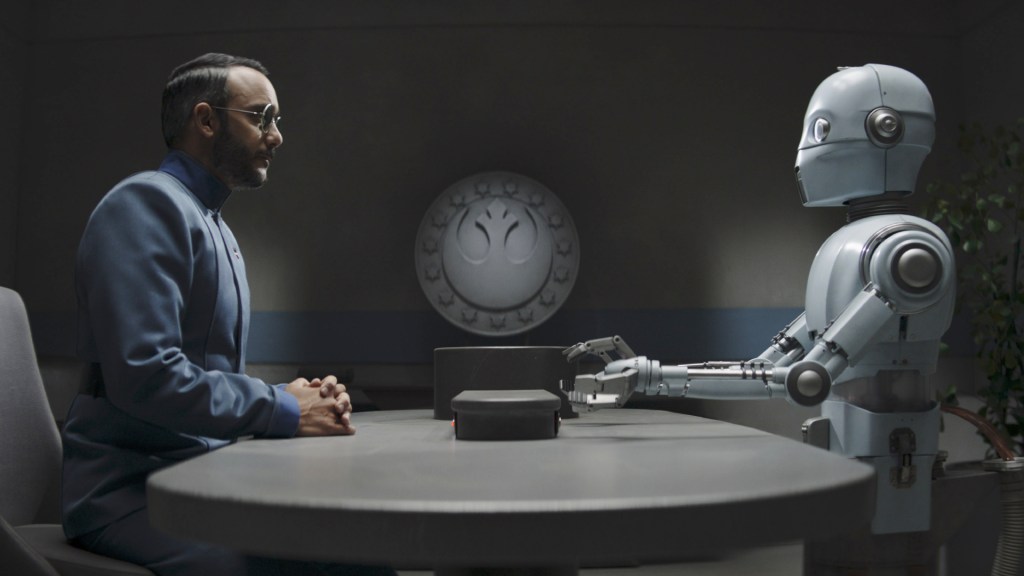
Throughout the season, small moments here and there hint that something is afoot under the nose of the New Republic; specifically, the ever-present threat of Imperial loyalists and even the possible escape of Moff Gideon after his capture at the end of Season 2. The foundation for this subplot is laid in Episode Three, The Convert, which for the most part is a self-contained adventure for the reluctant villain from previous seasons, Doctor Pershing (Omid Abtahi). Why the showrunners felt that this episode was necessary – I’m not sure – but surprisingly it ends up being the best part of the season by far; offering some much-needed worldbuilding in the realm of the New Republic and providing a complex examination of Pershing’s character and his motivations. Nevertheless, in the grand scheme of things all it really offers to the story is the revelation that ex-Imperial officer Elia Kane (Katie O’Brian) is still very much loyal to Moff Gideon, who is unsurprisingly still very much free, and working behind the scenes. Bizarrely, the show makes a pass at holding Gideon responsible for the actions of the pirates earlier in the season, which seems like a baseless and downright idiotic plot point to throw in after the fact, but nevertheless the whole subplot boils over as the season reaches its two-part finale, and the combined Mandalorian forces set their sights on reclaiming their homeworld at last. Of course, it turns out that Moff Gideon has a secret base on Mandalore, and after three seasons we finally get to learn the nefarious motives that fuel his every action – he wants to… make super-duper force-wielding Mandalorian clones of himself that he can use to take over the galaxy. Oh. Right.
It’s a good job that he gets blown up about fifteen minutes later, because I could hardly stand enduring any more of the sad reality that Favreau and Filoni took an actor as talented as Giancarlo Esposito and wasted him on a character that turned out be so goddamn lame. With an ending predictable to the letter, our heroes triumph after a grand CGI-fueled battle, leaving Moff Gideon’s Imperial Remnant forces finally defeated, Bo-Katan once again leader of the Mandalorian people, and Mando himself formally adopting Grogu into his clan – even though I’m sure this already happened at the end of Season One. The tribe of two retire to Nevarro, with Mando pledging to take up bounty hunting work for the New Republic (glad to know someone actually remembered this core tenet of the character), and it seems that the show leaves us with the option of following on with Bo-Katan and the rest of the Mandalorians as they rebuild their homeworld, or giving us more adventures with Mando and Grogu as it looks to future seasons. Still, neither prospect feels very exciting to me anymore, especially with how Mando has been sidelined this season before being dropped into this entirely unearned ending. Things are even worse for Grogu – although he sees a few more moments of independence this season that serve to make him feel like more of a character outside of Mando, beyond more dumb comic relief moments, there’s ultimately little more provided for him than another crumb of backstory; hammering home not only that the character shouldn’t have been brought back to the show so soon, but also that this mistake derails both he and Mando as characters, and by extension the entirety of the season.
One of the biggest advantages offered by Season One of The Mandalorian was its stellar production quality; offering a cinematic experience on a television budget, and Season Two only ramped things up on that front with a notable increase in budget. Sadly, like every other aspect of the show, Season Three drops the ball on this front too. First of all, set design takes a bit of a dive with many of the locations feeling patently artificial compared to those of the previous seasons, and even with many of the sets from this season meeting that standard of quality, it seems that the broader range of locales has stretched the show a little thin. This isn’t helped by an overreliance on the Volume soundstage as a substitute for shooting on-location – a problem also shared by The Book of Boba Fett – which quickly begins to shift The Mandalorian‘s sense of realism to that of artifice, even when the quality of the CGI still holds up to scratch. Another casualty of the show’s decline in production quality is its action scenes – I levied high praise upon Season Two for its excellent fight sequences, but anything in that vein quickly vanishes as Season Three offers up goofy, unimpressive action propped up by computerised editing that only serves to highlight its flaws, with nothing exemplifying that more than the laughably ridiculous visual of a CGI model of The Armorer jetpacking into battle wielding a hammer and tongs. The Mandalorian‘s original composer Ludwig Göransson doesn’t return for Season Three, and it certainly shows, with Joseph Shirley’s score lacking any distinctive sound beyond Göransson’s original themes, and that just seems to serve as the final indicator that the magic that went into this show’s first season is quickly running out.
In light of my criticisms, I feel that it’s prudent to say that this isn’t an awful season of television – it still retains plenty of the superficial aspects of The Mandalorian that the soy-chugging, Funko-collecting millennials will enjoy clapping and pointing at, but there isn’t much more to it than that. Any semblance of complexity in its characters quickly vanishes, while the potentially enjoyable plot is in reality muddied with the untimely return of Grogu and obtuse filler that further derails the story, and the steep decline in production quality is the final kick in the balls to remind you how far this show has fallen from grace. While it ties up many of the show’s original plot threads, I imagine the ending of Season Three is purposefully ambiguous as a precaution for how audiences react to the blatant decision to place Bo-Katan at the forefront of this season as opposed to Mando himself, but either way the sad fact is I don’t really care for The Mandalorian any more, regardless of where it takes its characters in the future. It’s another nail in the coffin for the once-great Star Wars, but given that it focuses on his prized original creation, I can only hope that Dave Filoni puts a little more effort into the upcoming Ahsoka series than he did here.
3/10


 A.J. Slater
Leave a comment