Jedi: Survivor takes everything great about its predecessor and raises it to new heights; boasting deeper combat, richer exploration, and a plethora of new gameplay features and mechanics that make it one of the best Star Wars experiences ever brought to bear. However, it also amplifies Fallen Order’s worst characteristics, as it offers another disappointing story that makes a messy about-turn away from the previous game whilst still falling a little short of delivering effective character writing across the board. To top it all off, the PC version is plagued by a horde of technical issues that have left the game borderline inaccessible for weeks; marring what was otherwise a highly enjoyable second outing for Cal Kestis and the crew of the Mantis, even in spite of the flaws in its writing.

It’s been just about three-and-a-half years since I reviewed Jedi: Fallen Order, which just so happened to be the first game review I ever wrote for this website – you can read it yourself here, but if you’d rather not, the long and short of it is that I did rather like the game. The gameplay was utterly fantastic, and while the story was little more than serviceable at many points, due in large part to a drastically undercooked cast of characters, revisiting the game recently has given me a newfound appreciation for its strong thematic core that deliberates on the nature of failure, as well as renewing my esteem for the game’s better aspects. As such, given that a sequel was already inevitable, when Jedi: Survivor made its existence known I was eager to see where Respawn would take the series next – from both a story and a gameplay angle – and I eagerly awaited the April 28th release date with my Steam pre-order locked in. However – upon release, it quickly became apparent that the PC version of the game was experiencing virulent technical issues (to the point where Respawn and EA released a statement of apology), and having seen the game in a near unplayable state myself – more on that later – I made the frustrating decision to wait until Jedi: Survivor had a few patches under its belt before I got stuck in.
Spoilers ahead!
Still, it paid off, and with a far more stable experience awaiting me, I dove headfirst into Jedi: Survivor as it picks up five years on from Fallen Order with an older and far more confident Cal Kestis (Cameron Monaghan) as he leads a ragtag crew of mercenaries on a mission to Coruscant to recover Imperial data for the Rebel fighter Saw Gerrera, who you may remember meeting in the prior game, although he doesn’t make a physical appearance here. It was an interesting choice to see Cal separated from his original group of friends and allies given how Fallen Order ended, but the fact that the game neglects to explain what happened between the crew of the Mantis beyond vague inference is ludicrous, especially since it appears to be an intentional move aiming to promote the game’s tie-in novel, and it was the first major red flag signalling the absolute mess that corporate interference seemed to have made of the game’s story. Nevertheless, as you might expect, Cal’s mission goes awry when he’s tracked down by The Ninth Sister (who you fought during Fallen Order‘s campaign), and after putting a mortal end to the hulking Inquisitor, I was sad to see that this was the last appearance of the specialist Jedi hunters for the rest of the game, considering how large a part they played in the prior entry, and it felt a little unceremonious to remove them from the plot entirely without a particularly definitive ending to that story thread. The level of disconnect between the plot of the first and second Jedi games becomes a quickly noticeable pattern as you progress through the story; your once-holographic guide, Jedi Master Eno Cordova (Tony Amendola), is all of a sudden un-“lost”, and the lingering question of what happened to the mysterious Zeffo species is waved away with a line of dialogue, before Cordova is soon after killed off, and it seems emblematic of a concerted effort to cut as many ties with Fallen Order as possible, for reasons that still elude me, but regardless it severely hurts the quality of the game’s story when it puts so much effort into hitting the brakes on so many ongoing subplots.

What Jedi: Survivor instead decides to pivot to is a blatant tie-in to the miserably underperforming “High Republic” multimedia project – no doubt mandated by those in Lucasfilm leadership who are still desperately clinging to the notion that it has the potential for any widespread investment amongst fans. It all starts when Cal crash lands on the world of Koboh on the search for his old friend Greez Dritus (Daniel Roebuck), so he can get the Mantis repaired following a rough escape from Coruscant and be on his merry way. After running afoul of local mercenaries, The Bedlam Raiders, Cal stumbles across the buried history of Koboh and its ties to the High Republic, which leads him to a centuries-old Jedi Knight named Dagan Gera (Cody Fern) who has been kept in suspended animation in Koboh’s Forest Array. Hoping to recruit Dagan to the Rebel cause, Cal frees him, but it turns out the mysterious Jedi fell to the dark side in his manic pursuit of controlling the hidden world of Tanalorr that lies beyond the Abyss above Koboh, and the leader of the Bedlam Raiders, Rayvis (D.C. Douglas) turns out to be Dagan’s loyal servant, as well as the game’s most enjoyable foe thanks to a simple yet enjoyable characterisation. Tanalorr becomes the MacGuffin of the story as most every character seeks to use the planet to their own ends, and in that way it actually serves as an effective focus for the story in helping us to understand what motivates each character. As for Dagan, although you understand what he wants for Tanalorr, the explanation of why – and for that matter, why he’s so evil – feels pretty much non-existent in the grand scheme of things, and with no personal connection to Cal it’s a struggle to feel any investment in him as a villain whatsoever. Ultimately the decision to tie Jedi: Survivor into the High Republic feels more like an anchor around the game’s neck, as it wastes precious screen-time on what is very clearly a dictated connection to other Star Wars media on the part of Lucasfilm that the developers struggled to incorporate into their vision for the game; not only hurting other facets of the plot but becoming the weakest part of the story in and of itself.
What I assume are the remains of the developers’ original story treatment are squeezed around this High Republic tie-in, as Cal reunites with his old mentor, Cere Junda (Debra Wilson), as well as the Nightsister Merrin (Tina Ivlev), who have both joined “The Hidden Path” – a Jedi-sympathetic rebel network first seen in last year’s horrendous Obi-Wan Kenobi series. The pair join Cal’s quest to reach Tanalorr, so they might uncover old Jedi secrets there, and the reunited Mantis crew is also joined by the dashing mercenary Bode Akuna (Noshir Dalal), who hopes to make Tanalorr a safe home for his daughter. As it turns out, Bode is a former Jedi; now working as an off-the-books spy for the Imperial Security Bureau who are using his daughter as leverage, and when his betrayal leads Darth Vader himself to The Hidden Path’s secret archive on Jedha, it results in the deaths of both Cere and Master Cordova. It’s a decent enough twist on paper, but having to work around the other elements of the plot means it lacks the necessary build-up to give it some oomph, and although he felt a little more realised than Dagan, I still wasn’t attached enough to Bode to have any sort of emotional investment in his betrayal. After a fun sequence spent infiltrating an ISB base to track down Bode, you finally make the perilous journey to Tanalorr and defeat him, which leaves the game on a surprisingly melancholy note as Cal is forced to kill his former ally, and the crew of the Mantis are left to take care of his young daughter. It’s a far more engaging part of the plot than anything to do with Dagan, but with how little time is reserved for it in the story, it wastes its potential for greatness, especially considering some of the best, yet painfully underwritten aspects of the plot such as Cal and Bode’s opposing viewpoints and the infighting between various arms of the Empire such as the ISB and the Inquisitorius. It certainly feels like the better of the two plotlines to conclude the game with, yet without sufficient groundwork, it fails to make an impact, and in the end it feels like the story suffers for being pulled between two very disparate preconceptions for the narrative.
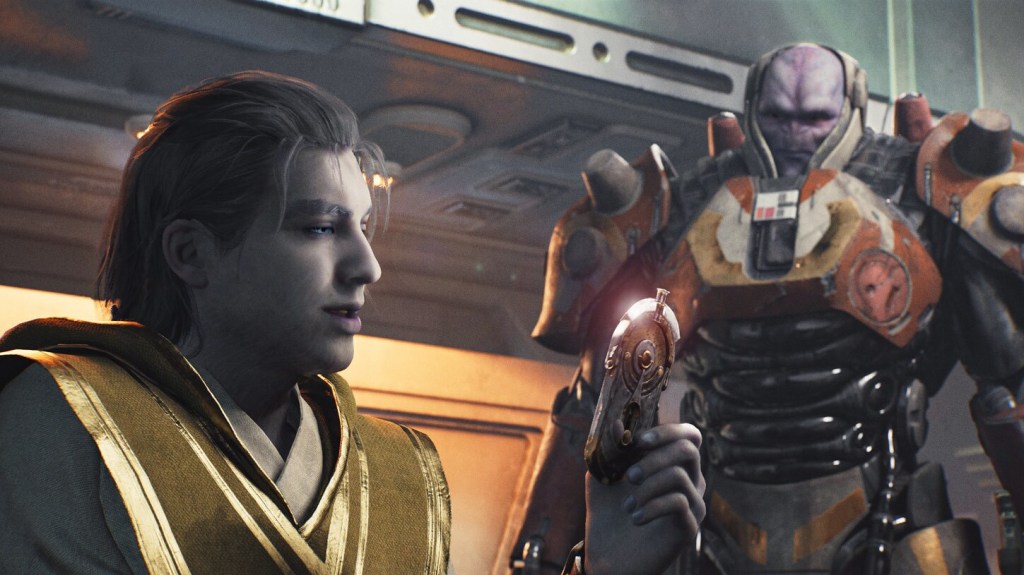
While Jedi: Survivor‘s villains leave a lot to be desired, it fares much better with protagonist and player character Cal Kestis, who finds some much-needed depth compared to his frankly bland portrayal in the previous game. Where Cal was guided through almost every step of his journey in Fallen Order by Cere, he’s now bestowed with far more agency and initiative in the story, complete with his own motivations where that previously felt sorely missing. As much as they might have disappointed in their own right, the story does draw some interesting parallels between Cal and both of the main villains; like Dagan, Cal seeks a position of strength from which he and his allies might strike back against the Empire, and like Bode, he’s also looking to protect his loved ones by providing them with a safe home, and Tanalorr becomes the manifestation of these goals for the young Jedi Knight to the point where it becomes an obsession for him too. This strengthens the game’s surprising new addition to Cal’s characterisation as he begins to take a darker turn – filled with doubt as to where his journey is taking him thanks to a relentless feeling that his acts of defiance are ultimately futile; all the failure and loss fuels Cal’s anger as the plot unfolds, and he begins to tap into the Dark Side of the Force towards the end of the story. It seems primed to be explored further in an inevitable sequel, thankfully rather than stuffing it into an already crowded narrative, but it’s a fantastic conclusion to draw from the events of the game and how they’ve impacted him. I was glad to see Cal feeling more like the true protagonist of the story as opposed to a player controlled minion who acts on the motivations of another character, but that hasn’t come without cost – Jedi Survivor leaves Cere feeling awfully waylaid; adding little to the story beyond empty platitudes for Cal and a wide, yet quickly glossed-over gap in her character that sits between the two games, and ultimately the decision to kill off both her and Eno Cordova seem like little more than an avenue for the writers to declutter the series after failing to decide where to take those characters and their respective story material here and in the future.
Still, the game thankfully fleshes out its other supporting characters where they were in dire need of a little more pronunciation – as before, Greez is still by-and-large the game’s comic relief, but he begins to grow beyond that as he gives voice to Cal’s desire to settle down and find a home away from the danger posed by the Empire, which is implied to be the main reason as to why he left the crew – even if the truth of the matter (as well as the story behind Greez’s missing arm) is hidden behind the Battle Scars novel. Merrin’s reasons for leaving feel equally vague, but she also gets a much bigger spotlight after having such little screen-time in the last game, which serves to make her a far more interesting character. Despite it taking place off-screen, Jedi: Survivor lends suitable time to explaining Merrin’s character development between the two games, that satisfyingly builds off what little characterisation she had in Fallen Order. Much like Cal, she feels far more mature and sure in herself, and it’s from that foundation that the writers guide the pair into a romance subplot, but it does feel somewhat rushed given that the pair are only given a short time to reconnect amongst every other component of the story, and I can only hope it’s expanded upon with more depth in future. While it may not reach the heights of greatness, the character writing in Jedi: Survivor is notable improvement over its predecessor, and even with the many faults I found with the plot, I was still very impressed with the thematic elements that the story derives from its characters and their motivations. Jedi: Survivor is deeply rooted in explorations of purpose, family, internal conflict and self-sacrifice, that make the story feel far richer in spite of its flaws, as well as differentiating its thematic elements from those of the previous game when it could have easily rehashed the same subtext in the framing of this story. Truthfully, the characters and themes offered by Jedi: Survivor‘s story give the game some welcome heart that manages to cut through the otherwise chaotic web of plot that the writers have stitched together; elevating the game beyond its biggest shortcomings.
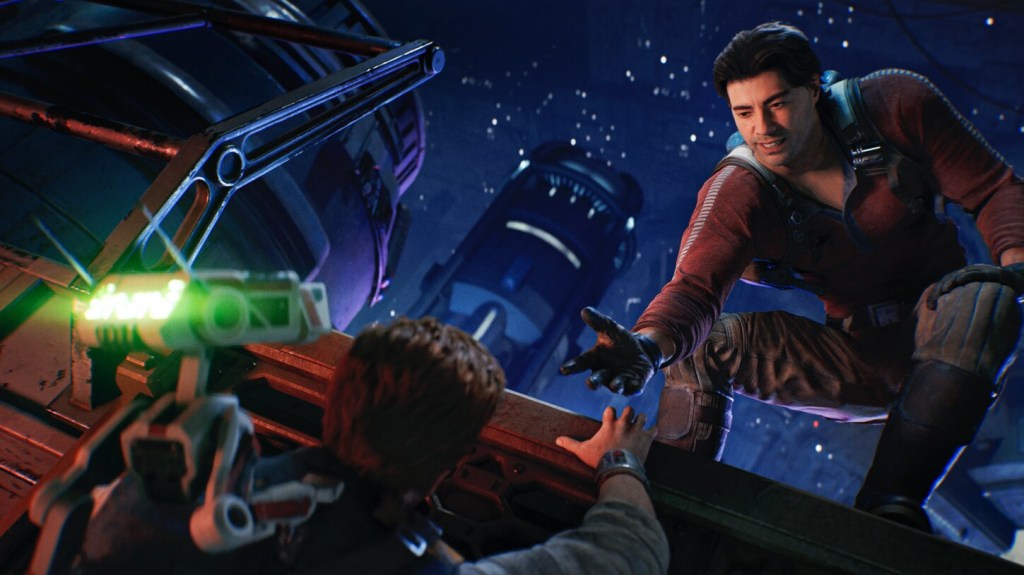
Still, much like its predecessor, Jedi: Survivor outshines the inadequacies in its story with the excellence of its gameplay, and even when I was more than satisfied with what Fallen Order had to offer, its sequel not only proves there was plenty of potential for improvement, but takes full advantage of that opportunity too. Combat sees a massive overhaul with the introduction of Stances, expanding on the first game’s choice between the single and double-bladed lightsaber with the addition of the fast-moving Dual Wield, slow yet heavy-hitting Crossguard, and the ranged-melee hybrid Blaster Stances that you’ll unlock over the course of the main story. Although you’re limited to two Stances at a time, the greater variety of combat forms gives you a nice degree of choice as to how you approach the game at large, or with the opportunity to change them out at Meditation Points you can change up your playstyle for specific situations if needs be. Each Stance comes with its own respective skill tree that allows you to further hone your chosen fighting style with new abilities and upgrades, and as well as creating a near-constant learning curve as you add more moves into the mix, it’s also just nice to have that higher degree of freedom in how you approach the game’s combat. That dedication to player choice is echoed not only in the extensively expanded visual customisation, but also with the addition of the new Perks system that allows you to further tweak your playstyle with small bonuses where you need it most. Add an array of new Force abilities into the mix, as well as the ability to direct your allies in combat, and you’re certainly given a lot of tools to play with, which is just as well given the horde of challenging new enemies you’ll face across the game. Compared to Fallen Order, I found myself changing up my approach to various enemies far more often, giving the combat a refreshingly strategic feel, which in turn makes the game’s boss fights especially enjoyable (even the frustratingly difficult ones!), and it just speaks to the quality of the combat mechanics to see the developers take an already robust system and improve on it so much anyway.
As great of a role that combat played in Fallen Order, it was met with equal importance by the traversal and puzzle-solving sequences that sat between each combat encounter, and that hasn’t changed going into to Jedi: Survivor, nor have the developers neglected to expand upon those mechanics either. The sequel offers larger, more open spaces in its six planetary destinations that allow for freer exploration whilst giving the worlds a less linear and gamified feel, and you’ll gain access to more areas the further you progress into the story as you pick up new abilities like Force Lift, Air Dash, and even a pair of projectile types that can be shot from your droid companion BD-1. These mechanics also factor into the puzzle sequences, which felt like a vast improvement over those of the previous game, not only because of those additional tools, but also coming across as more thoughtful and challenging, which made them something I grew to look forward to rather than just enduring them on the way to the next bout of enemies. Another welcome improvement Jedi: Survivor brings to the table is in how it populates its worlds with more than just main story levels and breakaways for collectables – now providing a solid offering of side content that doesn’t fall into the trap of open-world bloat either. The new Rumours system offers a number of small side-quest-ish activities you can go off and complete at your leisure, including a string of Bounty Hunting objectives that serve as a small, self-contained story for you to complete, with a satisfying cameo at the end for those that do. The largest of the maps, Koboh, offers a small hub area in the form of the Rambler’s Reach Outpost, and the more side content you complete, the more the town comes to life as an eclectic cast of characters join the settlement, and it even gives you something to show for some of the collectibles as you populate the Saloon’s fishtank and rooftop garden. It might not be anything special, but the additional content can be a nice break from powering through the story, and it definitely puts your shiny new abilities to good use as you explore Jedi Survivor‘s environments.

You’ll certainly be able to appreciate the game’s environments at a visual level too – even if I found them to be lacking the notability that Fallen Order‘s planets offered, on top of feeling a little less diverse than I would’ve liked, there’s no denying that they’re both well-made and incredibly detailed. I was also glad to see that the developers made use of Koboh’s size to incorporate a range of biomes and environments into that map, as opposed to giving it a blanket aesthetic that could’ve become quickly tired out at such a scale. The game offers a strong design language that can be identified at a number of levels; between the elegant whites, golds, and intricate patterns of the High Republic, the dark, oppressive sharpness of the Empire, or the time-worn ancient architecture of Jedha, Jedi: Survivor feels right at home in the Star Wars universe, whilst enjoying the ability to blend those aesthetics together in a way that elevates the less memorable parts of the game’s locales. As much as their reputation might suffer elsewhere, it’s at least safe to expect a high level of graphical fidelity from EA’s flagship titles, and Jedi: Survivor doesn’t disappoint – aside from the general advantages of being upgraded for next-generation hardware, the game also enjoys the long-requested dismemberment physics in combat, as well as a massive improvement in the facial animations that does away with Fallen Order‘s infamously bug-eyed facescan of Debra Wilson. However, these enhancements have clearly come at a cost – as I mentioned earlier, Jedi: Survivor was besieged by absolutely egregious technical issues at launch, seemingly as a result of poor optimisation more than anything, and I myself suffered from sporadic frame-rate drops and some frustrating visual bugs, but it was the relentless crashes that made me give up on the game until it’d been patched into a more suitable state, and this to me is a pretty unforgiveable pitfall for a game on release, especially a triple-A title riding on money from one of the biggest publishers in gaming, not to mention one of the biggest brands in entertainment as a whole.
Still, as much as the technical issues soured my experience with the game at launch, getting over that hump didn’t stop me from enjoying what Jedi: Survivor does have to offer. I can’t stress enough that from a gameplay standpoint, you’re in for nothing short of brilliance here, even when I couldn’t see all that much room for improvement coming out of Fallen Order. It’s certainly a good job, because as much as it might’ve improved when it comes down to the characters, the writing would by no means carry this game on its own, thanks to the chaotic plot left in the wake of that sudden pivot away from the story set out by the previous game, and what I suspect is the interference of Lucasfilm in trying to incorporate the High Republic into the narrative where it really wasn’t necessary. Surprisingly, in spite of feeling let down by the writing, and certainly irritated in the face of the game’s technical issues, I still had a damn good time with Jedi: Survivor on the back of its gameplay and the better aspects of the story. Although I’d stress making sure your machine is up to the challenge should you decide to play it on PC, I’d still quite happily recommend giving the game a go, and with the interesting position in which it leaves its narrative, as well as the potential for further developing the already-excellent gameplay mechanics, I’m excited to see where the Jedi series will go next.
7/10


 A.J. Slater
Leave a comment