Vast, yet painfully shallow, Starfield doesn’t lack for great characters, fun missions, and enjoyable storylines, but they’re few and far between in a galaxy swamped with dull and meaningless filler. Add in a noticeable lack of innovation and identity, and it’s clearly left trailing behind Bethesda Game Studios’ other flagship titles – however, it also leverages that connection to imbue it with an addictively engrossing gameplay loop; providing you with a wide range of tools and a practically endless sandbox that yields a satisfying level of freedom in how you approach it.

Since I ever really got into videogames, I’ve always maintained a bit of a radar as to upcoming releases I might want to play, and now close to a decade ago I first heard mention of something called Starfield, which originally permeated into the public consciousness by way of a trademark filed by Bethesda Studios’ parent company, ZeniMax Media. Rumours and leaks of varying credibility ran wild for many a year as to what Starfield really was, but lo and behold in 2018 it was revealed to be Bethesda Game Studios first original IP in twenty years, taking the shape of a space exploration role-playing game in the vein of Fallout and The Elder Scrolls, the studio’s flagship titles. As a locked down fan of Bethesda’s games; Skyrim being one of the first games I ever played on PC, and having no less than one thousand hours logged in Fallout 4, I was naturally invested from the get go, not just out of some sense of consumer loyalty, but because I think Bethesda is one of the few developers that has a handle on what makes their games tick. So, some five years of radio silence, repeated delays, further leaks of dubious credibility and eventual legitimate reveals later, Starfield has finally landed in the hands of consumers, and with a Premium Edition pre-order, I was raring to go come September 1st.
But wait! In my eagerness to get stuck in, I had vastly overestimated the capabilities of my gaming PC, now well beyond its golden years. Upon playing for a few hours, and being plagued with crash after crash that only became more ceaseless the further into the game I got, I realised that Starfield was beyond the reach of my humble rig. Despair set in, and as I scrambled to organise a refund, my hubris only became more apparent; having exhausted too long a playtime, I was not only left without any means of playing the game, but £85 out of pocket too. I was ready to chalk this up as a complete disaster, but my little did I know my salvation was soon on the horizon. About two weeks after its release, Starfield was made playable through Nvidia’s GeForce Now cloud gaming service, and while it meant shelling out an extra £18 for a month’s subscription, it runs smoother than butter on the service’s Ultimate tier servers – and it certainly beats having to buy a whole new machine to play the game. After making a new character, and occupying these last few weeks with many, many sessions extending into the lonely hours of the night, I’ve seen about all I can stomach of Starfield, and naturally it’s time to render a final verdict, so buckle in – it’s gonna be a long one.
Minor spoilers ahead!
Like most other Bethesda games, Starfield begins with a carefully curated introduction; setting up the main story, giving you a relatively simple environment to learn the basic controls, and allowing you to create your character for the journey ahead of you. From a visual standpoint, Starfield‘s character creator felt like somewhat of a step backwards compared to Fallout 4, with an obtuse UI and puzzling restrictions, but the backgrounds and traits system gives it an edge when it comes to roleplaying, allowing for your character to have some fun skills and advantages (or disadvantages) later down the line. Nevertheless, your character’s discovery of a mysterious Artifact whilst on a mining job sets you on the path to joining a diverse organisation of explorers called Constellation, where among the cast of the main story, you’ll also find the game’s four main companion characters. It’s admittedly a disappointingly low number, and it stings even more considering they all belong to the same faction, basically all have the same opinion on your choices and generally just fail to hold a candle to the companions from previous Bethesda games. Your arrival sparks their hunt for more of these Artifacts, and you’ll spend the majority of the game’s story saving Constellation members from various pickles and venturing across the Milky Way in search of the other Artifacts. To be blunt, I didn’t much care for Starfield‘s main story – the whole “Chosen One” shtick is tired enough as it is, and my distaste was only compounded by the repetitive nature of the main missions that see you travelling to various procedurally generated locales to scoop up more Artifacts. A couple of shock twists in the middle of the game briefly makes things a little more exciting, and some of the more carefully designed missions in-between all the padding proved to be fun, but it just isn’t enough to distract from the broader monotony of the main plot, and as far as Bethesda campaigns go, it ultimately felt bland and forgettable.

The whole reason for your Artifact treasure hunt is eventually revealed to you, being that they are pieces of something called the Armillary; an alien device that once assembled allows you to travel into a place called the Unity, that when passed through will allow you to become a multiversal being called a Starborn. Not just a title, this also affords you special powers (which makes it feel even more derivative of Skyrim), as well as a fancy spacesuit and ship; the downside being that sparing your level and skills, you’re forced to start fresh in a “new universe”, which just acts as a built-in New Game Plus mode. There, you have the choice to repeat the entire main story, or skip it in favour of a single mission collecting more Artifacts that pushes you right up to the final mission and allows you to pass through the Unity again – a process that can be done as many times as you please. Now, you might be wondering to what end you would do this. Might you learn more about the origins of the Artifacts, Temples, Armillary or Unity? Or in the infinite span of the multiverse, could you end up in a universe drastically different from the one you left? Well, the answer to both of those questions is no. Firstly, almost all of the information you learn about the Artifacts is disseminated to you by two other Starborn – the righteous Emissary and the villainous Hunter, and any understanding they have of the mysterious “Creators” is hidden behind empty platitudes. An alternate version of your player character also awaits you inside the Unity, who is equally useless in providing any insight into the backstory of the Creators, and it really just feels like Bethesda couldn’t be bothered explaining their own storyline. As for leveraging the multiverse as a storytelling possibility, if you’re lucky, you might wind up discovering a few alternate versions of Constellation when you enter a new universe, but it hardly impacts the game at all, meaning that all you’re really left to show for your effort is six tiers of spaceship to earn, ten tiers of spacesuit to unlock, and the odd dialogue option to remind you that you’ve done this all before.
It’s surprising, then, that while the main story was a let-down, and the endgame content was frankly utter shite, Starfield does actually have a lot of stuff that’s worth experiencing. For one, it follows suit from other Bethesda games with the inclusion of a variety of Factions you can join, each with their own short questline. I played two of these, entering both the shady corporate world of Ryujin Industries, as well as the dusty frontiers of space with the Freestar Rangers, and I have to say they weren’t half bad; offering solid storylines and unique rewards to boot. Ryujin was the standout of the two, being the only real avenue for you to explore a darker side to your character, as well as being surprisingly lengthy and allowing you to undertake a good variety of mission types. The Freestar Rangers questline was a little shorter and far more simple in nature by comparison, with many of the missions lacking in complexity and excitement, but it did offer a neat little story and a trove of unique rewards for completing it. Outside of the larger questlines, there is of course a hoard of one-off side missions strewn across the vast galaxy, and while some are little more than quickly completed errands, there’s plenty in the way of well-written and engaging side quests too; complete with unique characters, special rewards and even some lasting decisions in a few cases. A personal favourite can be found in the Porrima System, where the resort planet of Paradiso is beset by a strange starship that doesn’t answer any communications, and it’s left up to the player to unravel the mystery and decide the fate of the ship. Surprisingly, one of Starfield‘s most simple joys comes in the form of its random encounters; there’s no end to the fun little interactions you might happen across when travelling across the stars, from dining with a friendly grandmother and answering questions for a field trip to being set upon by pirates or deciding the fate of a sentient A.I. – they make the galaxy feel a little less empty and proved to be some of my fondest experiences with the game.
As much as the writing proved to be a let down, Starfield redeems itself through its biggest strength – cold, hard gameplay. The tried and tested core mechanics borrowed from the likes of Fallout and The Elder Scrolls serve as a strong foundation, that with some small tweaks makes the gameplay feel slick and refined, and this applies most of all to the combat, which feels engaging and impactful right out of the gate, albeit a little too easy even on the “Hard” difficulty. There seems to be a renewed effort on Bethesda’s part to diversify the ways you can approach combat, especially considering the wide range of environmental factors on offer, from hidden, stealthy routes through levels and reprogrammable robots that will take out your enemies for you, to a variety of destructible objects and the relentlessly enjoyable Zero Gravity combat. Unsurprisingly, an vast arsenal of weaponry also awaits you, with something to suit just about everyone – and if not, a deep and varied modification system allows you to tweak your firearms to your desired specifications. What really sets Starfield apart from other Bethesda titles is of course the ships – not only are they the key to getting around the game’s vast galaxy, but they open up a new arena for combat too. While the limitations placed on space travel with its relentless loading screens and shoddily masked lack of freedom has rightly earned some flack, the ships are just generally fun to fly around in, and the space combat brings with it a neat learning curve and a variety of weapon types to utilise depending on what suits your playstyle best. That commitment to player choice is demonstrated twofold through Starfield‘s skill system; a five part offering that gives you a wide variety of acquirable talents under the Physical, Social, Combat, Science and Tech trees, and on top of this individual skills can also be levelled up through the completion of relevant challenges, which proved to be a solid way to both progress your skills and encourage you to actually use them as well. Although I personally found the ever-growing gap between levels meant I was quickly falling short of the points I needed for the skills I wanted later in the game, the skill system still proves to be an excellent way to further your refine your chosen playstyle.
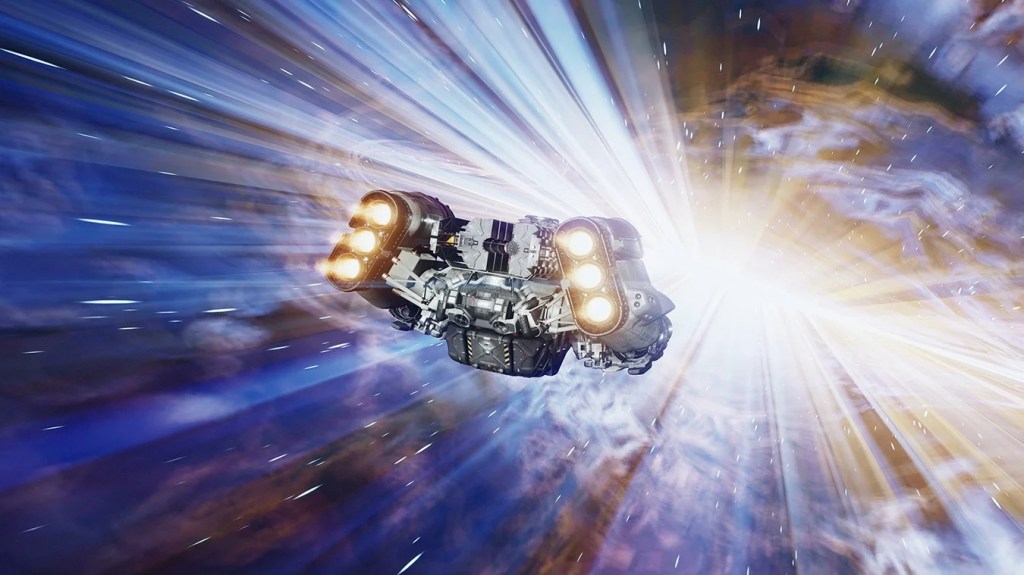
Despite its shortcomings in other areas, there’s a lot to be said for what Starfield offers players in terms of freedom across its galaxy-sized sandbox. If the main quest, nor any side quests tickle your fancy, you’re free to blaze your own trail across the galaxy and partake in any number of fun little activities. You can pick up odd jobs from multiple types of Mission Boards, giving you the chance to hunt down space criminals, or transport passengers across the galaxy, or spend your time exploring the stars; surveying planets and analysing their resources, flora and fauna. Planet variation did feel a little limited; missing volcanic worlds in the vein of Star Wars‘ Mustafar (as did 2016’s No Man’s Sky), but should you find the right planet for you, whether at an aesthetic level or because of its resource yield, Starfield‘s Outpost building mode will come in handy. Not too dissimilar from Fallout 4‘s Workshop Mode, Outposts present you with a wide range of pre-built “Habs” for you to construct the space base of your dreams, which you can then fill out with various workbenches and furnishings, but most important of all are the Resource Extractors, that when powered will sucker up various crafting materials in the area ready for storing away. These can then be manufactured into a variety of goods ready for sale or transport, should you choose to embrace your inner space trucker, or for further use in constructing some of the other odds and ends the Outpost mode has to offer. As fun as Outposts might be, they certainly didn’t capture my attention quite like the ship designer did – a very extensive (and addictive) customisation mode allows you to build and modify up to ten starships to your exact specifications, with various vendors and manufacturers offering different components across three tiered classes throughout the galaxy, and I personally spent hours upon hours constructing a fleet of ships to fit every whim of my imagination. Truth be told, I was surprised to find that it was Starfield‘s least structured and scripted elements that proved to yield the most enjoyment, and I think you really get the most from this game when setting out and exploring the galaxy on your own terms.
Where Starfield proves not to be the most thrilling experience is certainly in its approach to design. Bethesda’s enduring reliance on the Creation Engine makes the game feel outdated right off the bat, especially when it comes to things like animation and creating a sense of scale in the game’s cities, and for a Bethesda game it goes without saying that it was swarmed with all manner of bugs and glitches. It also begs the question why this game is so fucking tasking on hardware when it doesn’t even look particularly good; sure, there’s a lot of nice environments and some of the assets do look very detailed up close (albeit unnecessarily), but the fact is the game isn’t exactly going to be winning any awards for its visuals, and hey, fuck it – I’ll go as far as saying the shiny plastic veneer lathered all over the game’s graphical design even feels like a downgrade from the now eight-year-old Fallout 4. The same can be said when considering Starfield from an aesthetic standpoint – I can see where the developers were headed with their “NASA-punk” design ethos, but between that and the inspirations the game draws from futurist, western and cyberpunk aesthetics, it ultimately feels stretched thin and loses any sort of distinct identity. Really that lack of identity is what fails to elevate Starfield beyond its means; it just doesn’t stand out in the same way that the Fallout series does, where you can easily point to a distinguished setting and feel it has to it, and it also lacks the rich lore and carefully designed locales of the Elder Scrolls series too, despite drawing proven elements from both to create that “Bethesda feeling” in its story structure and gameplay. Beyond a couple of select pieces, Inon Zur’s droning, uninspired soundtrack only compounds that feeling, especially when much of the score feels like it could have been pulled from Fallout 4 anyway. Truthfully it feels like Starfield is kind of cobbled together from bits of everything except itself, like some soulless Frankenstein’s Monster trying to be Skyrim, Fallout, Mass Effect and No Man’s Sky all at once, but being spread so thin it ultimately falls short of them all in just about every conceivable way.
Although my words might have felt harsh, the truth is I did enjoy Starfield. I mean, I must have to an extent given I sat through close to 150 hours of what it had to offer, but in all seriousness I found it to be a fun game, plain and simple. However – that’s not to say it was a good game, because in all honesty it isn’t. Starfield fails to deliver at multiple levels, and in arguably some of its most important facets like story and design, and as much as I did enjoy it, it’s plain to see why; it’s a Bethesda game through and through, and if that isn’t your cup of tea, Starfield won’t be either. I think that’s where I have to place the fulcrum for my recommendation; a timid “yes” conditional on what you make of games that did this, except better, and if, like me, that appeals to you, I’d say give it a go. Even then, I don’t see myself sinking the same amount of time into this for years to come the way I’ve done with Fallout 4 or Skyrim – nothing I’ve seen of it excites me enough to revisit it, nor does the prospect of anything I’m yet to touch upon entice me either. DLC expansions are already confirmed to be on the way, which will certainly draw me in for the promise of new content, but I think for the time being I’ll lay Starfield to rest.
5/10


 A.J. Slater
Leave a comment