The three-part event celebrating Doctor Who’s 60th Anniversary proves that the series is well and truly dead, and even with the return of cast and crew from the show’s glory days, it seems the once beloved tentpole of British television is beyond salvation. Comprised of uninspiring, one-shot stories with no overarching narrative; the three episodes hardly constitute a worthy commemoration, and when combined with an extremely disappointing standard of writing from the once-great Russell T. Davies, and the eyewatering level to which the specials are stuffed with ideological lecturing, it’s clear that Doctor Who has squandered its last best chance for redemption.

Like most everyone I know in my social circles, Doctor Who holds a special place in my heart as one of the storytelling cornerstones of my childhood. From the moment I first sat and watched the Christopher Eccleston revival run with my dad, I was absolutely hooked; I had toys, costumes, collectable cards, board games, video games – even Dalek shampoo bottles. I thought the world of Doctor Who as a child, and for the most part, the episodes I grew up on still hold up very well on revisit years later. But as time has gone on, those questions my friends and I grew up asking each other – “which Doctor is your favourite?”, “what alien is the scariest?”, “who’s your favourite companion?” – all turned to one question only: “when did you stop watching?”. It’s no secret that the show has seen an ostensible decline over the years, through the changing hands of increasingly incompetent writers and a growing resolve to shoehorn left-wing political ideology into the show, which left it in tatters in the eyes of a once loyal fanbase.
Doctor Who didn’t just lose its audience, but its reputation too, and well into Jodie Whitaker’s turn as the 13th Doctor, not even I could stomach watching the careless degradation of a once beloved staple of British culture. After long enough, it seems the BBC finally caught on to what fans have known for years, and a massive overhaul of the show saw them pull out all the stops on a last ditch effort to capitalise on nostalgia by bringing back not only Russell T. Davies as showrunner and Murray Gold as composer, but dragging David Tennant and Catherine Tate back to play the Doctor and his former companion Donna Noble respectively for a three part series of specials to commemorate the show’s 60th anniversary. Although skeptical, I too fell to a mix of morbid curiosity and twinging nostalgia, and resigned myself to tuning in over these last 3 weeks, and if nothing else, the episodes have at least been ripe for a review.
Spoilers ahead!

The three-episode event kicks off with The Star Beast, and right from the beginning I had very little faith in what was to come. Breaking from the show’s tradition, we pick up with the newest (if you can call it that when bringing back your most popular actor to the role) incarnation of the Doctor (David Tennant) some time after his regeneration from the Jodie Whittaker iteration, as he lands back on Earth and quite literally just walks right into former companion Donna Noble (Catherine Tate) and her family, before a burning spaceship conveniently crash-lands right near them to set the main plot of the episode in motion. It isn’t much to rave about; taking the shape of a goofy, by the numbers caper about an alien refugee being hunted down by other aliens, all leaving chaos in their wake, before an incredibly predictable twist reveals that the supposedly adorable Meep is actually an intergalactic fugitive who wants to destroy the world, and it’s quite hilariously characterised by the character’s change from a surely Baby Yoda-inspired puppet to an uncanny CGI replication with an “evil” face.
You can’t even give it points for originality, given that the episode is actually a direct adaptation of a 1980 comic storyline that originally starred Tom Baker’s Fourth Doctor, but it works in a subplot that aims to resolve the lingering ramifications of 2008’s Journey’s End, that saw Donna depart as a companion after having her mind wiped. Since then, it remained a key notion that were she to ever remember The Doctor, she would face certain death, but The Star Beast reneges on that conclusion through… the power of transgenderism? A painfully vague explanation tosses aside that plot point, and any real stakes the specials had going for them vanish in favour of vacuously singing the praises of transsexuality. It doesn’t end there, with blatant lectures on pronouns and wheelchair accessibility being dropped into the script with all the subtlety of a bulldozer; proving that despite their attempts to capitalise on nostalgia, the minds behind Doctor Who still value their politics above telling a good story. It’s with that that The Star Beast proves to be a paltry initial offering in the lineup of specials, and I promise you it doesn’t get much better.
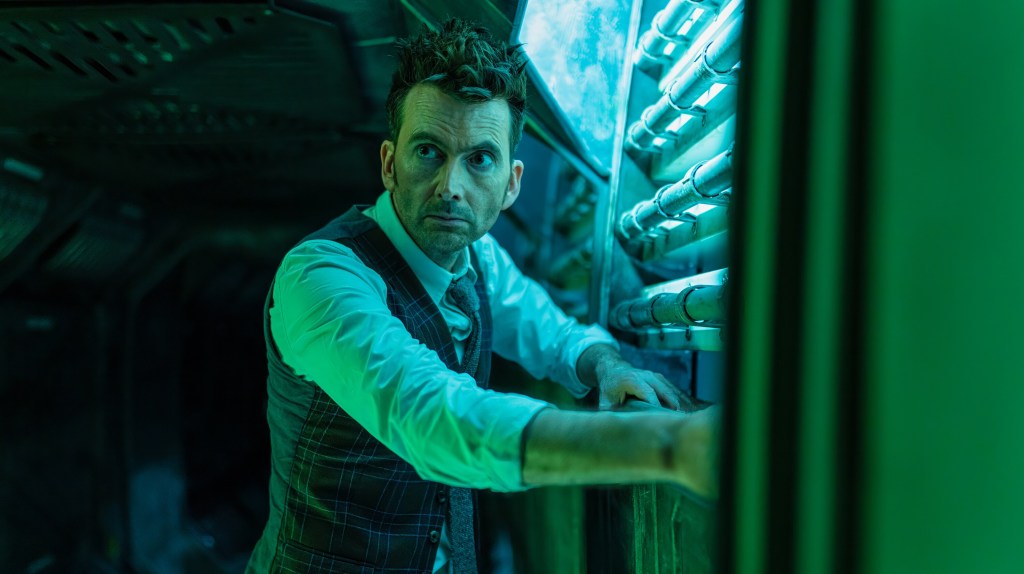
Where The Star Beast is just plain awful, the second of the specials, Wild Blue Yonder, proves to be one of the blandest stories that Doctor Who has ever brought to the screen. After Donna… sigh… spills coffee on the TARDIS console, the Doctor’s iconic time machine transports viewers into an entirely pointless scene that seems to exist only for the purpose of smugly displaying a race-swapped Sir Isaac Newton, before near enough exploding as it lands inside an abandoned spaceship at the edge of the universe. When it senses danger abound, the TARDIS disappears again and leaves The Doctor and Donna stranded – it’s not the most original idea for a Doctor Who episode, but it’s at least a little more interesting than the previous special – on paper anyway. In execution, Wild Blue Yonder is a slow trawl through the dreary, computer generated halls and compulsively reused sets of the empty starship; delivering a lacklustre mystery that isn’t even propped up by the feeble attempts at some sort of introspection for our characters, and how their lives and dynamic with each other might have changed since last they saw each other.
What you get instead is a bunch of pratting about from the CGI-disfigured David Tennant and Catherine Tate, who also play the episode’s villains; a pair of nebulous entities from outside of the known universe that struggle to understand concepts of shape and size and seek to escape from the deserted spacecraft. The bulk of the episode is made up from laughably bad chase scenes with one or both of the actors engorged through CGI in some way, as well as repeatedly tiresome scenes of the characters bumping into their doppelgangers and eventually realising something is off about them before running off again. In the end, our heroes solve the mystery, escape from the ship as it explodes, and leave the villains trapped inside, and after it was all said and done it proved to be one of the most downright tedious hours of television I’ve ever had the discomfort of sitting through. I still remain genuinely unsure what was stronger between The Star Beast‘s ability to make me roll my eyes, or Wild Blue Yonder‘s capacity to send me to sleep, but nevertheless the latter concludes with the disappointingly unceremonious final appearance of the late Bernard Cribbins as one-time Wilfred Mott, before a cliffhanger ending that leads into the final of the specials.

Last up is The Giggle, which judging by the way it helmed the advertising for the Anniversary Specials, was likely where most of the creative energy went, and given that it ends up being the least shit out of the three episodes, it seems to have paid off. Right away you’ll notice it feels decidedly more like the Doctor Who you remember, with a cold open that introduces the episode’s villain, The Celestial Toymaker (guest star Neil Patrick Harris); originally from a First Doctor story from back in 1966. Back in the present day, The Doctor and Donna return to find chaos on the streets of London, as everybody on Earth now embraces violent impulses because they think themselves to be “right” all the time – it’s a little clunky, but it’s also the best premise the show managed to come up with between all three specials, so make of that what you will. Anyhow, the Doctor teams up once again with the fictional UNIT (now based in a suspiciously Avengers-like tower in the middle of London), who discover that a subliminal message broadcast from a television satellite is responsible for the mass psychosis, and deducing that it originated from the first ever television broadcast, the Doctor and Donna travel back to 1925 to investigate.
The pair find themselves facing off against The Toymaker, with some surprisingly well done horror elements that stem from the villains godlike powers, including seeing characters trapped in the form of killer puppets, which feels like it could be right out of the early Russell T. Davies era. Returning to the present, The Toymaker attacks UNIT after they destroy the satellite and break his spell, which for some reason takes the form of a cringeworthy Spice Girls dance number. The episode begins to wrap up rather sporadically, as the Doctor is promptly lasered through the chest by the Toymaker, and the most ridiculous moment from across all three specials comes as The Doctor “bi-generates”; spitting in the face of 60 years of lore and storytelling as The Doctor becomes two separate iterations between David Tennant and newcomer Ncuti Gatwa. Between this, the wholly pointless inclusion of former companion Mel Bush (Bonnie Langford), and miserably amateur dialogue, it’s not really saying much that The Giggle still manages to come out on top out of the three specials by far, but it manages to maintain a little charm reminiscent of the show’s past that keeps it a cut above the rest.

Altogether it’s safe to say the 60th Anniversary was a bust – especially compared to the likes of 2013’s The Day of the Doctor, but even more so it can’t really even live up to the quality of any of the episodes from Russell T. Davies’ first tenure, which I’m only reaffirming as I sit here and watch Series One after it auto-queued on iPlayer. The obvious problems in writing aside – I also think that the largely self-contained nature of each special did more harm than good, given that it negated the opportunity to have a longer, more focused narrative that would’ve made it feel like more of an “event”. The biggest draw of the specials was undoubtedly the return of David Tennant as The Doctor, but with no satisfying explanation as to why this incarnation of the Doctor returned in the story, it’s clear that it was a haphazard attempt to cash in on nostalgia and prime some wayward viewers for a new iteration of the show. The “bi-generation” plot point also seems to confirm a rumour that I happened across some months ago that suggested that the BBC was looking to produce a limited series starring Tennant and Tate that would run concurrently with Gatwa’s tenure on the main show, and after all this I can’t say the prospect excites me.
I can’t really think of much positive to say with regards to these specials; sure the performances are there, especially with Ncuti Gatwa bringing a lot of energy to his first appearance as The Doctor. Despite being bankrolled by Disney (and judging by a lot of the eerily Marvel-esque visuals, inspired too), the CGI and visuals are pretty poor, including the strange decision to shoot the episodes in sixty frames-per-second, and even Murray Gold’s score doesn’t seem to strike in the same way it used to, with the most memorable pieces of the soundtrack being reprisals of other tracks from the show’s past. At this point I think I’ve said all I need to about the writing, so with that I’m quite happy to wipe my hands of this experience. I might check out the Christmas special, and will likely have a crack at Gatwa’s first season for review purposes, but with my confidence in Russell T. Davies writing ability shattered, and any hope that the BBC might have learned their lesson in prioritising ideology over storytelling vanished, I’m certainly under no pretence that Doctor Who is saved, and this point I’m not sure that it ever will be.
2/10


 A.J. Slater
Leave a comment