Poor Things wows in its beginning with a fantastic premise and an enchanting aesthetic, but cracks begin to show as it becomes more and more apparent that the film offers far more lazily prescribed style than tangible substance as it descends into an increasingly muddled mess of vague thematic subtext and increasingly eye-rolling rhetoric. This comes to a head with a completely jumbled ending that knots all of its plot threads together at the last moment before actively spitting in the face of the story up until that point.
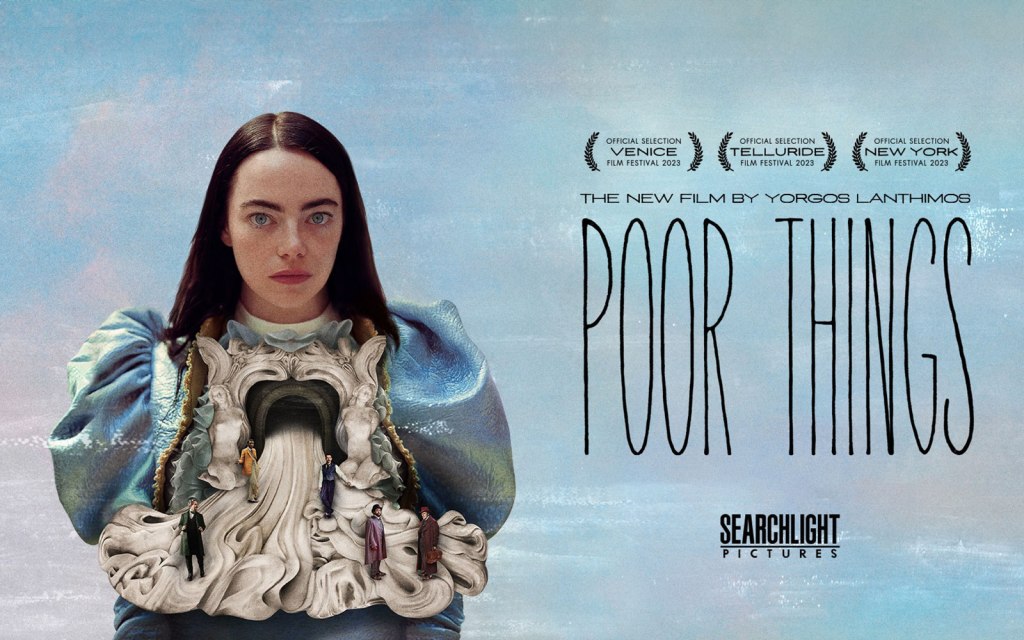
I can’t say I’m overly familiar with Yorgos Lanthimos’ body of work, but I enjoyed the Greek filmmaker’s period piece The Favourite after seeing it for the first time last year, thanks in large part to its strong dialogue, great characters, and the even greater performances that brought them to life. I wasn’t all that aware of his latest release, Poor Things, but after it saw a theatrical release in the United States towards the start of December, I started hearing a flood of praise for the film, and after some much-needed investigation into some promotional material, I was enamoured by its unmistakably unique visuals and interesting premise and soon found myself compelled to watch it. Unfortunately, I was forced to wait for the film’s delayed release in the UK, but as it turns out – I wasn’t missing out on all that much.
Spoilers ahead!
Wasting little time getting underway, Poor Things introduces us to Max McCandles (Ramy Youssef), a medical student in a somewhat nebulous Victorian London, as he’s hired as an assistant by his eccentric and wildly disfigured teacher, Godwin Baxter (Willem Dafoe). His task is simple; he is charged with assisting in the care and teaching of Godwin’s ward, Bella (Emma Stone), who at first glance appears to have some sort of developmental disability, as demonstrated through her extremely childlike demeanour and poor motor skills. As it turns out, Bella is Godwin’s latest twisted experiment; in reality being a woman dead by suicide, with the healthy brain of her unborn child transplanted into her skull and reanimated with electroshock treatments. As much as I thought the film should’ve spent more time building up the truth of Bella’s origins for a heavier impact, as well as further exploring Godwin’s motives behind the experiment, it was nevertheless a fun twist on the classic Frankenstein story as the monstrous-looking doctor gives life to the pristinely beautiful experiment. Bella becomes increasingly intelligent under Max’s tutelage, but grows equally rebellious too, and the film derives a lot of its best comedic moments from her antics here and later on in the story. She also begins to delve into her sexuality, which is a strange choice considering that the character is for all intents and purposes still a child, and I found it all the more confounding that Max begins to fall in love with Bella and commits to marrying her, with an alarmingly absent exploration of the implications of this blatantly predatory relationship.
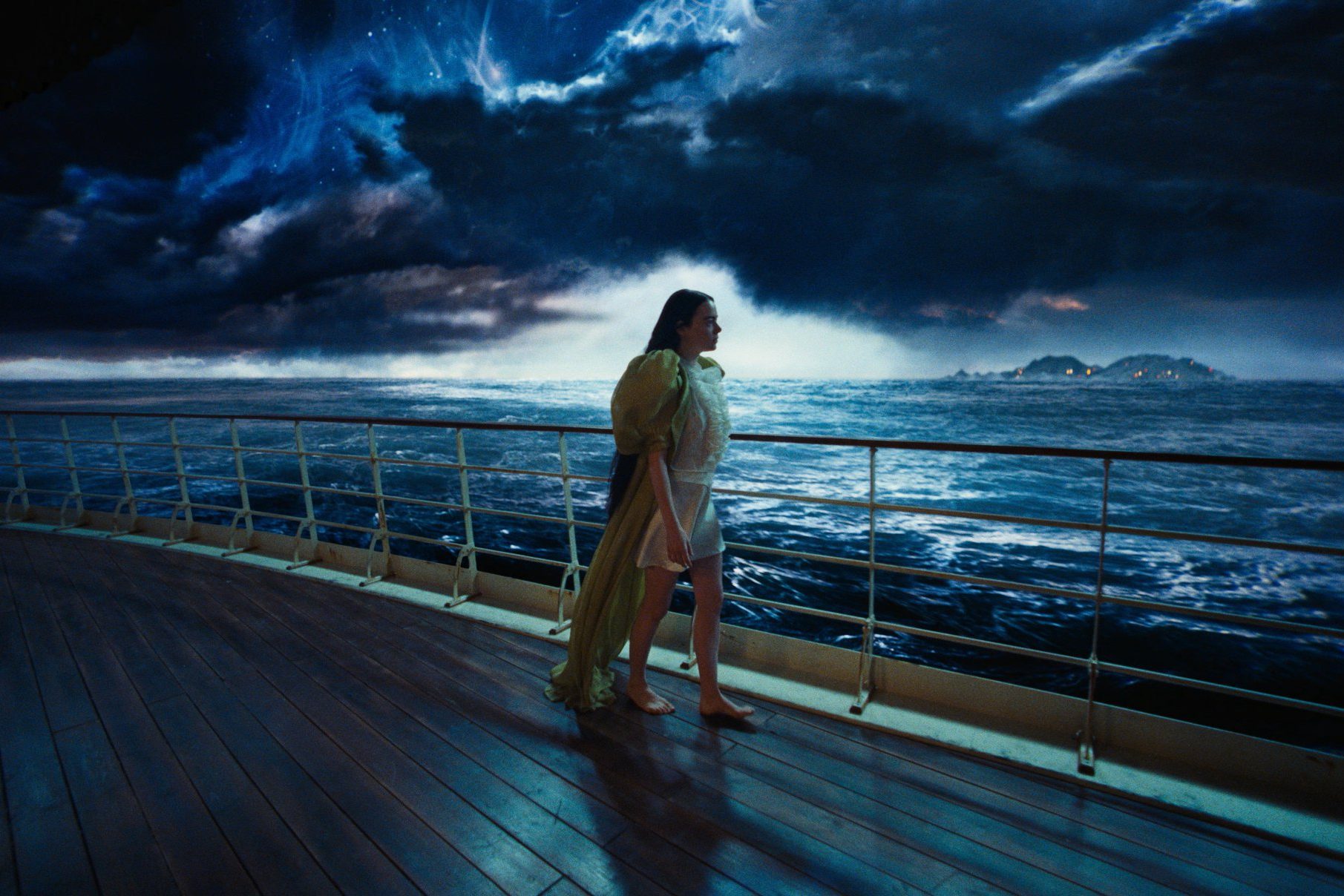
It’s a little less creepy when Bella elopes from her confinement with Godwin’s lawyer, the womanising Duncan Wedderburn (Mark Ruffalo), who without knowing the truth of her condition, overlooks her deficient mental faculties in favour of her natural beauty. Max and Godwin are sadly left feeling waylaid for the middle chunk of the story, especially with how it neglects to explore on the more interesting aspects of their characters from this point, but the plot nevertheless shifts focus as Duncan takes Bella away to Lisbon with the pair engaging in relentless sex and other such excesses of pleasure. As Bella’s eyes are opened to the wider world, she grows continually more independent much to Duncan’s frustration, and Ruffalo proves to be the highlight of the film as he plays hilariously on Duncan’s increasingly exasperated attempts to keep her under control that send him into a spiral of insanity. As the pair continue to travel around Europe, Bella is introduced to all that the world has to offer from joy and beauty to hate and suffering, and seeing humanity through the lens of her naive, childlike outlook is really the emotional core of the film, both as she projects her innocence onto others, as well as how that purity is taken advantage of by those Bella puts her trust in. She also starts to engage in deeper, philosophical concepts – which does seem a little fast given the fact she still continues to speak like she has a mental handicap – but it further compounds Bella’s spirit of independence and provides her with an endearing characterisation that sees her trying to embracing kindness in an otherwise cruel world.
Free of Duncan’s control when the pair arrive in Paris, Bella becomes a self-sufficient prostitute in some strange attempt to portray selling your body as empowering, and while there’s undeniably a concerted effort across the story to toot the horn for female sexuality, it doesn’t actually have anything interesting to say on the matter, instead choosing to portray male sexuality as creepy and disgusting by contrast despite the fact that it all just seems like an excuse to repeatedly get Emma Stone naked on camera. Nevertheless, Bella returns to London at last when she learns that Godwin is dying, and after deciding of her own volition to go ahead with her marriage to Max, their wedding is crashed by Alfie Blessington (Christopher Abbott), who’s pregnant wife Victoria was the woman who’s body was used to create Bella. It feels totally out of left field to introduce this plot point so close to the end of the story, but after leaving with Blessington, Bella discovers that he is an intensely controlling and violent man who confines her to his mansion and plans to subject her to genital mutilation. Following a final confrontation, he’s fatally injured and Bella is able to escape, yet after spending the bulk of the film touting the need for kindness in the world, Bella decides of all things to transplant a goat brain into Blessington’s head and keep him as an unwitting prisoner, and as the film draws to a close with Bella settling down on Godwin’s estate with her cuckold husband and her socialist lesbian lover, I couldn’t believe how far the plot had spiralled out of control; losing any sense of flow and completely destroying Bella’s characterisation.
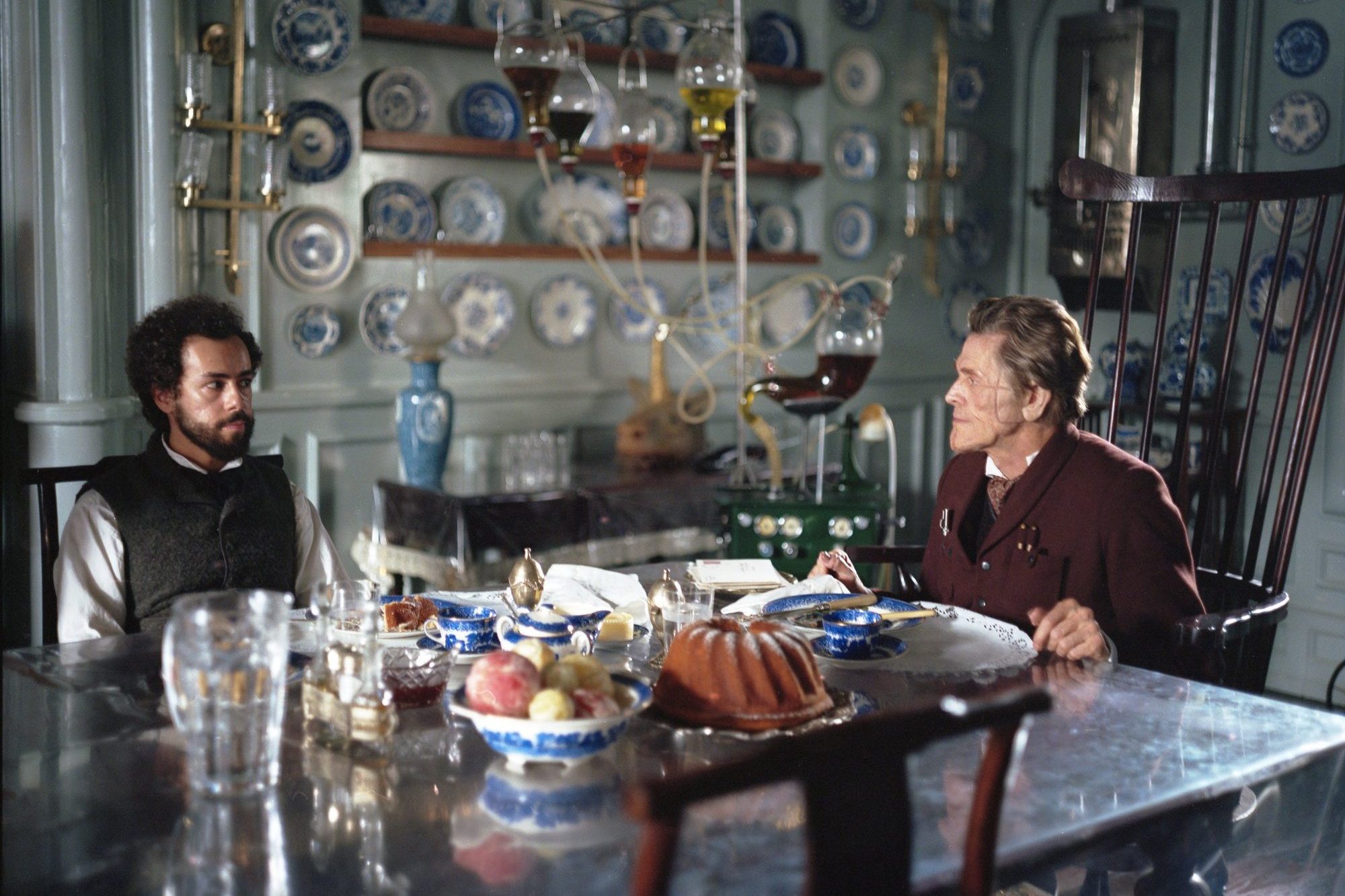
You might find a distraction from the plummeting decline of the writing quality in Poor Things‘ captivating visual style – the exaggerated architecture, beautifully colourful skylines, extravagant costume design and the unusual steampunk-inspired aesthetics give the film a distinctly dazzling visual language and an unrivalled air of surrealism that compliments the strange nature of its premise. However, the phrase “too much of a good thing” springs to mind as Lanthimos continues to lather on visual techniques that feel wholly unnecessary – for one, the entire London opening is shot in black and white for some reason, and as much as I’ve pored over my notes and my recollection of the film, I can’t for the life of me figure out what the significance of this was beyond being used as a stereotypical tool of the aspiring arthouse flick, much like the movie’s unorthodox aspect ratio. The same goes for the repeated use of a fish-eye lens and keyhole shots that have zero significance for the moments they’re being used with, and the further into the film I got, the harder I found it to shake the feeling that Lanthimos was just throwing anything vaguely considered to be avant-garde at the wall and hoping it would stick, and sadly it ends up undercutting the visual elements of the film that did feel like they complemented the story. It also became quickly irritating that the film neglects to subtitle its extensive foreign-language segments, which left me feeling disconnected from some of those lengthier dialogue exchanges, but there is at least a lot of fun music cues that are well timed with the dramatic turns in the plot and changes in character’s emotions.
Still, between the excessive use of highbrow visuals and the tired left-wing talking points lazily applied as subtext to the story, it’s not hard to see that Poor Things is deep into “Oscar-bait” territory, and it seems to me that the root of all the film’s praise has come from people who felt like they were smart for pretending to enjoy it. I for one think that all the effort put into soliciting award nominations would have been better spent putting together a competent plot with consistent characters, but hey – what do I know? Even in spite of what I enjoyed about Poor Things, its faults do a lot of irreparable harm to my overall estimation of the film, and although I opted for the higher of the two ratings I was considering, I’m still not sure that’d I recommend giving it a go without preparing yourself for some serious disappointment.
5/10


 A.J. Slater
Leave a comment