The final season of The Bad Batch rights many wrongs of the Clone Wars continuation’s prior entries; offering further insights into its main cast of characters and finally doing away with the unnecessary adventure-of-the-week format that held back the show’s wider plot development. However, Season 3 remains far from perfect thanks to an overarching story that starts to crack under the weight of its own repetitiveness, and for the end of the show in its entirety, I was surprised to find that the conclusion lacks any emotional weight or narrative oomph whatsoever – leaving the series hanging on a wholly unsatisfying finish.

I’ve hardly been on good terms with The Bad Batch over the last few years, after the middling-at-best Clone Wars continuation got off to a rocky start with an embarrassing first season that wasted the immense potential of its premise in favour of happy-go-lucky weekly adventures featuring a frustratingly one-note cast of characters. However, Season 2 did hammer the show into something marginally serviceable; offering some much-needed characterisation for its titular heroes, as well as a more corporeal overarching story that existed beyond the first and last couple of episodes in the season. Still, it wasn’t perfect by any means – the season was still plagued by filler episodes, and as much as some characters saw an improvement, others somehow declined even further – but with that said, it just about managed to be a palatable watch (you can read my full review here!), and it was undoubtedly a step in the right direction for the series at large. However, with the news that The Bad Batch‘s third and final season was set to premiere just under a year later, the pressure was mounting for the show to deliver a worthy conclusion that could see the series finally flourish in its own right, and although with it all said and done that hasn’t been the case, that’s not to say that Season 3 hasn’t made strides to improve itself either.
Spoilers ahead!
The Bad Batch picks back up on the dour note where Season 2 left off following the death of original team member Tech (and yes, he really is dead), and the capture of the squad’s young protégé Omega, who serves as the focus of the premiere episode as the show explores what fate has befallen her at the Empire’s secretive Mount Tantiss research facility. Omega starts out strong this season with a heavy emphasis on character development – not only is she aged up in her appearance, but she also feels far more mature and capable in her behaviour; losing a lot of that “annoying kid” demeanour that made her such an intolerable screen presence, and it soon becomes clear that as much as she tries to remain hopeful, the monotony of her routine and the oppression of the Empire are beginning to wear her down. The end result of this is personified through Crosshair (also imprisoned at Tantiss), who’s long-awaited turn against the Empire wasn’t the straightforward redemption arc you might have expected – he’s left unsure of himself and constantly tries to dissuade Omega from acts of defiance. That fear and doubt manifests as a tremble in his hand, which essentially strips away the core tenet of his identity in his skill as a marksman, and it was nice to see it used as a plot point for his character throughout the entire season as opposed to being waved away prematurely. Despite not having much screen time with one another previously, Crosshair’s relationship with Omega remains strong after they make their escape from Tantiss, and the dynamic is at its best in those moments when he feels alienated from the other members of the squad, and altogether it really feels like they get the strongest characterisation across the final season.

Of course, that leaves the question of where the other characters stand – while Omega and Crosshair are trapped under the Empire’s thumb, the remaining squad members Hunter and Wrecker set out to find their captured comrades and the elusive Tantiss base. You might think that with the squad cut down to nothing more than a duo, there might be room for some juicy character work for Hunter and Wrecker (who most certainly needs it), but you’d unfortunately be wrong. Hunter remains entrenched in the exact same characterisation he’s held since Season One with a one-note focus on Omega’s safety, while Wrecker – although far less irritating now that he isn’t solely acting as comic relief – still lacks anything discernibly interesting in his character. It would’ve been apt to see the pair reflect a little more on their journey and how it’s cost them near enough all they hold dear, and this applies especially so to Hunter given that he’s led the team every step of the way, but in the grand scheme of things they do little more than facilitate most of the season’s action sequences – which aren’t even that exciting seeing how The Bad Batch has long since given up on showcasing any of Clone Force 99’s unique abilities. You may be wondering where Echo fits into all this, especially since there’s a much larger opening for his abilities in the team since the death of Tech at the end of the last season, but it seems the writers settled on him remaining outside of the main story; only showing up to lend a helping hand in a smattering of episodes and left with an unceremonious blink-and-you’ll-miss-it conclusion for his character. Voice talent Dee Bradley Baker once again does his best to bring the team of Clones to life, but it’s sad to say that for the majority of the main cast this season, there’s hardly been anything to work with.
I will grant that the team’s reunion at the end of Episode Four is not only one of the most powerful moments not only in this season, but across the show as a whole, and Hunter and Wrecker’s ensuing conflict with Crosshair is probably the most interesting attributed to those characters in Season 3, even if it doesn’t last for very long. The same goes for Omega’s predicament in general – she’s only away from the team for less than four episodes, and in truth none of the other characters really have all that much agency in her escape, which begs the question of why they’d devote an entire episode to Hunter and Wrecker tracking her down only to pull the rug out from under you. Still, the writers at least came up with something relatively solid to drive the team for the bulk of the season, with our heroes remaining committed to locating Tantiss so they might free other Clone prisoners there and uncover the truth behind the Empire’s cloning experiments, and I was stunned to see that not a single episode in Season Three was wasted on some ridiculous, off-kilter adventure that contributes nothing to the wider story; one of my biggest criticisms of the previous seasons, given that it wasted the tremendous potential of the show’s premise to spend its runtime on frivolous filler episodes. Things do move a little slowly, and it’s clear that some of the narrative is constructed around battering you with exposition or bringing in certain characters such as The Clone Wars‘ Asajj Ventress (with Dave Filoni stepping over his own established lore once again given that the character is supposed to be dead), but Season Three works far better than its predecessors for delivering a streamlined overarching plot unburdened by a blatantly strung-together adventure-of-the-week format.
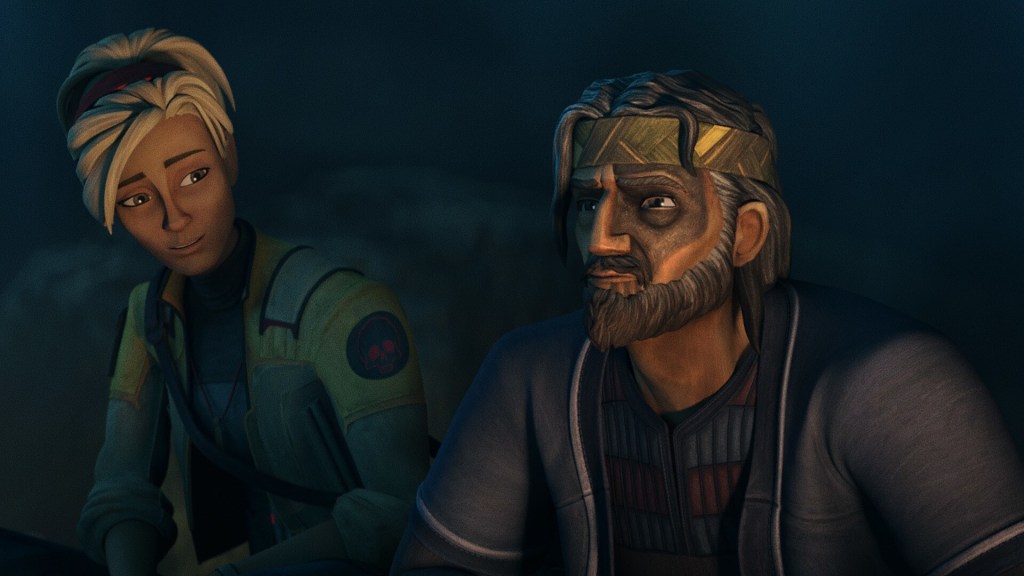
Bizarrely, in spite of the decision to have Omega escape from Tantiss at the beginning of the season, the writers decide to have her recaptured by the Empire and sent back at the end of Episode 11; walking back on basically all the plot development surrounding her character barring the fact that she knows a little about what the experiments are for, and similarly setting the other characters back to square one until Crosshair conveniently remembers that an imprisoned Imperial Admiral knows the location to the base. Omega also meets some other children imprisoned on Tantiss, but beyond a link to “Project Necromancer” (the in-universe codeword that highlights whenever Lucasfilm’s Story Group are trying to rationalise the disastrous use of Emperor Palpatine in The Rise of Skywalker), details of what is actually going on at the base are exceptionally vague – and probably intentionally so. Main villain Doctor Hemlock is never more than the soft-spoken face of the Empire, and although his assistant Doctor Karr has a halfway-decent redemption arc across the season, there’s nothing lent to any of the deeper mystery behind her character, and that really speaks to the show’s countless branching mysteries in their entirety. The finale itself feels equally unsatisfying – sure, Crosshair loses a hand, but there’s no tangible sense of stakes or emotional weight when every main character exits the story with a happy ending, and without any sort of accompanying revelation about the wider lore the concluding episodes hardly feel any different to The Bad Batch‘s standard fare, which is hardly a desirable look when it comes to wrapping up an entire series.
Truthfully, as much as Season Three makes some much needed improvements on its predecessors, it’s ultimately too little too late for The Bad Batch, with its insubstantial ending proving to be the final nail in the coffin for a series that has squandered its potential at every turn. Where the show was poised to explore a rich, untapped era of Star Wars history and explore the changing relationship between the Clones and the Empire, it instead became bogged down in a frivolous and childish approach to storytelling that facilitated its showrunner’s compulsion to plaster his favourite creations over as much media as possible, and as much as it’s made incremental improvements over the years, The Bad Batch has hardly scratched the surface of that initial premise. The show has certainly overcome some of those flaws; offering a more direct story across its final season and providing at least some of its main cast with solid character development, but as much as it might have improved in some areas, it falls behind in many other aspects with its repetitive, unengaging story content, overlooked protagonists, and unsatisfying connections to the wider universe, and when the series desperately needed to go out with a bang, The Bad Batch is ultimately left to fizzle out.
4/10


 A.J. Slater
Leave a comment