The Great Circle is crafted with a true reverence for Indiana Jones; folding the very essence of the original trilogy of movies into every facet of its production while endeavouring to deepen the source material rather than shamelessly replicate it. The writing doesn’t always stick the landing, nor is it the most mechanically creative title ever produced with a fair share of technical issues to boot, but the game is a more-than-commendable effort on the part of the developers, and more than anything proves that Indiana Jones still has a future – even if it is away from the silver screen.

Life gets busy sometimes, and reshuffling my day-to-day around a new job has meant that I’ve found myself hard-pressed trying to squeeze in time for gaming lately, but if there was one title I wasn’t going to miss this year, it was Indiana Jones and The Great Circle – and that’s saying something, given that I had a lot of reason to be apprehensive in the lead-up to release. Some of what I’d seen was promising, but there were some glaring red flags from where I was standing – Troy Baker didn’t quite feel right as Indy, being locked in to a first person perspective bordered on ludicrous, and I certainly wasn’t filled with confidence for the franchise after the disaster that was last year’s final Indy adventure on the big screen, The Dial of Destiny (you can read my full review here!). In spite of it all, I still love Indiana Jones; I always have, and I probably always will – The Last Crusade is an unbeatable comfort movie in my book, and the character as a whole simply defines the adventure genre, so against my better instincts I slapped down a whole lot of money on a pre-order of The Great Circle‘s Premium Edition, spent even more on a GeForce Now Ultimate subscription so my aged PC could actually play the game, and come December 6th I was raring to see what this adventure had in store for me.
Spoilers ahead!
Outside of the major trailers, I had made a point of trying to go into this game somewhat blind, so it was a very pleasant surprise to see The Great Circle open with a faithful recreation of the intro to Raiders of The Lost Ark; not just one of the most iconic sequences in the franchise, but in the entirety of cinema, and I think it’s actually a pretty good place to start the story with that element of sheer nostalgia to satiate die-hard fans while dropping the more casual audience into a scene that is more or less universally recognisable. Moreover, it sets the stage for the beginning of The Great Circle‘s original story; taking place a year after Raiders, a down-on-his-luck Indy is living out of his office following his split from love interest Marion Ravenwood, who’s absence, and by extension the events of the original movie, feed into the game’s narrative here and there. Things pick up quickly when a hulking stranger – brought to life by the late, great Tony Todd – breaks into the college, effortlessly incapacitating Indy and making off with a valuable artifact, but leaving behind a vital clue that spurs the titular adventurer into action as he sets out to track down the mysterious giant at the Vatican. It does feel like the plot is rushed out of the gate a little, and I think some more time spent exploring Indy’s headspace at the beginning would’ve served the story better, but I can appreciate the writers trying to convey the notion that Indy is using the opportunity of an adventure to escape from the turmoil of his personal life. We learn that it was indeed his archaeological obsessions that drove Marion away, and later on we also find out that Indy’s adventuring has lost him his job too, and I actually thought it was a very interesting avenue for the game to explore the character in a way that hadn’t really been done before by portraying the dichotomy between the adventuring hero and the man at home. It’s a shame however that this subtext doesn’t really go anywhere – there’s no catharsis or conclusion for the character by the end of the story, so I can only hope that MachineGames plans to explore this idea across future instalments rather than wasting of one of this game’s most interesting ways of adapting the character.
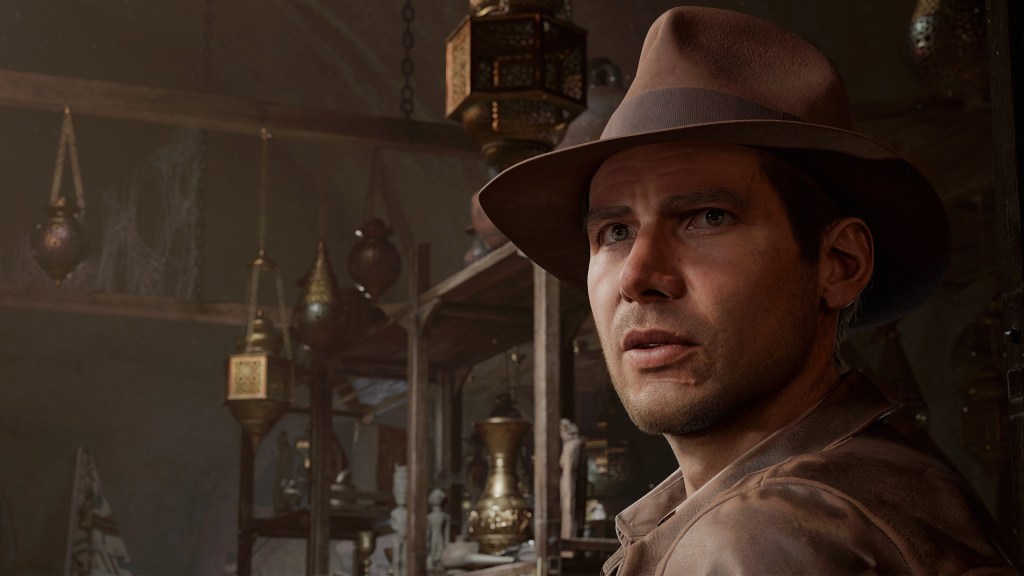
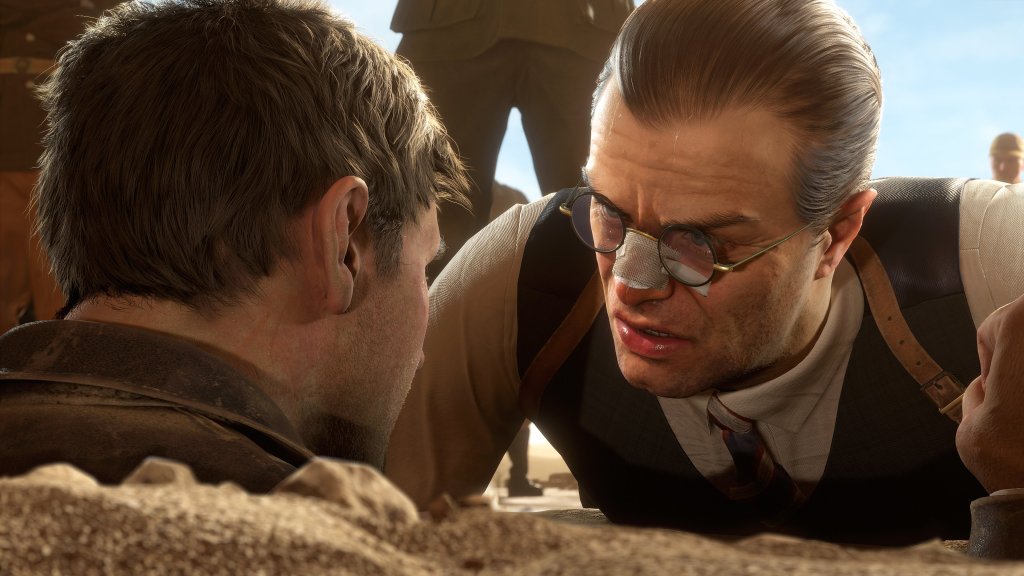
Anyhow, the adventure picks up in Vatican City, where Indy goes undercover as a member of the clergy as he tries to track down the giant and the secretive order to which he belongs, while ducking the interfering presence of Italian Fascists (including the brief appearance of real-life dictator Benito Mussolini) in the Holy City. Aided on his way by an old friend in the Church, Father Antonio, I thought it was a nice touch for the game to incorporate another classic Indiana Jones staple by representing his abundance of allies across the globe, both here and in other locations in the story, as well as enshrining the use of disguises as a more prominent part of both the gameplay and the plot. Though on the surface it may seem like a concentrated recycling of tropes, I feel like the game exercises its creative strength quite early on by using the Vatican as its first major setting – while not boasting hidden temples tucked away underneath dusty deserts or verdant jungles as we’re so used to seeing across much of the franchise (and will absolutely encounter later on in the story), the gilded halls of the Holy See are equally steeped in a rich and long history, and I felt that the extent to which the game leverages the location in conjunction with those classic Indiana Jones clichés carried an air of innovation that The Great Circle very much needed to avoid feeling stale. As the story progresses, we’re soon to run into two more figures key to the fabric of an Indy adventure in love interest Gina Lombardi and conniving villain Emmerich Voss – both of whom carry a strong screen presence thanks to excellent performances, but who unfortunately also are left wanting for the same sort of depth. A keen journalist on the hunt for her missing sister, Gina maintains an entertaining volley of wits with our titular adventurer, but the romantic element of their partnership is flimsy at best, and lacking any sense of conviction or emotive strength in her motivations leaves her feeling a little bland at the best of times – as for Voss, his shared history with Indy and his fascination with psychology were an untapped wellspring of interesting characterisation, but both characters just lacked that little bit of attention needed to elevate what was otherwise fine into something spectacular.
Another key character who really needed a little more substance was Locus, the mysterious giant from the beginning of the game who is revealed to be a member of the secret Nephilim Order; a hidden cabal of giants who guard the secret of the titular Great Circle, and while it seems that the upcoming Order of Giants DLC for the game is poised to shine some light on their importance, the role of the giants in the story thus far certainly felt like it was lacking for both weight and necessity. Nevertheless, we eventually learn that the Circle itself is an inexplicably perfect ring of holy sites mapped around the globe, and that hidden in their most sacred relics lies ancient stone artifacts – naturally, Indy chases down Voss from the Vatican all the way to Giza, Sukhothai and beyond as the rival archaeologists race to collect the stones, with our hero trying to uncover their secret and protect their heritage while his nemesis seeks untold power to fuel the Reich’s war machine. The bulk of the story really isn’t all that dissimilar from the likes of Raiders or The Last Crusade, packed with humour and action alike that feels perfectly in keeping with the classic movies (even if it would have been nice for some of the fight scenes to have a little more interactivity), and the mystery at its heart kept me pretty well engaged as the pieces came together. That said, it was only towards the very end of the story where I felt things got a bit rocky – we learn that the individual stones are able to transport their wielder to specific locations on the Great Circle, and that when brought together aboard the real Noah’s Ark of all places, it allows full control over the power of teleportation – only I felt that even with a very traditional Indiana Jones ending to the story, a lot of that information is sort of just thrown at you with virtually no set-up. Still, in spite of what it was lacking, The Great Circle‘s narrative was by no means a terrible one, but I honestly think it wouldn’t have worked nearly as well without Troy Baker’s utterly transformative performance as Indiana Jones – sure, there are odd moments where the illusion breaks, but frankly I found my doubts misplaced and then some after witnessing Baker absolutely disappear into the role; breathing new life into cinema’s most famous archaeologist.
Of course, I’ve had plenty to say about The Great Circle as an Indiana Jones story, but as a game it also has a lot to prove – after all, the medium is the message, and no matter how good a game’s story is, it doesn’t mean shit unless it keeps players engaged with its mechanics. Luckily for MachineGames, they just about manage to pull it off; for the most part using the formula of their renowned Wolfenstein titles where it works, and diverting from it where it doesn’t, they ultimately serve up a core gameplay loop that, while a little uninspired, is functional and almost refreshing in its simplicity. The four pillars of The Great Circle‘s gameplay are easily broken down into sections focused on combat, stealth, puzzle-solving and exploration respectively – the first of which offers up pretty decent melee mechanics that support both bare-knuckle beatdowns and an absolute horde of objects dotted around the game’s maps for you to use as weapons and oftentimes projectiles too in true Indiana Jones fashion. The variety of enemies, while quite limited, at least tries to make things a little less monotonous, and the game also includes some boiler-plate shooting mechanics – though it clearly imparts that this is a last resort option given how punishing it is, with enemies rushing your location and in many instances showering you in bullets as soon as shots are fired. Stealth is highly encouraged where possible (though in most instances being set upon by a group of soldiers isn’t exactly a challenge) but sneaking around and administering brutal takedowns is arguably the least entertaining option available thanks in large part to the near-dysfunctional AI, which goes for both enemies and player companions alike. Though I did appreciate how the game leans into the identity of its player character in how you overcome your foes, for me, The Great Circle was at its best when it lets you embrace Indy as the archaeologist – even if the vast majority of the puzzles weren’t exactly rousing headscratchers, using your in-game notes, environmental clues and plain old intuition to find a path forwards through the levels brought with it the kind of classically fun mechanics and honest sense of accomplishment that many games seem to outright overlook nowadays.
Offering up a total of seven locations around the globe, exploration is arguably the largest element of The Great Circle – you won’t be left totally stumped if you’re struggling to find your way, but I appreciated that for the most part the game allows you to figure out where to go, and solid traversal mechanics that borrow from Indy’s on-screen adventures make it pretty fun to navigate the maps. I still stand firm that a third-person perspective would’ve served the game far better, but I think it lives up to the legend of the character in many other ways; the iconic bullwhip is a valuable tool in all four arenas of gameplay, and collectable Adventure Books level up your existing abilities and unlock new ones that help you settle into your role as the iconic adventurer. You’ll also pick up a small helping of additional tools as you progress through the game that open up further avenues for exploration, and while on the one hand it might’ve been nice to have a little more complexity in the gameplay, I think it ultimately makes the experience feel a little cleaner and more authentic by largely sticking to Indy’s skills and equipment as seen in the movies. Exploration is also the name of the game when it comes to The Great Circle‘s secondary content – every location has its fill of collectables, but the three largest maps provide a wealth of additional narratives outside of the main story, including longer, story focused side quests called “Fieldwork”, as well as shorter stories or gameplay segments that fall under “Mysteries”. Though some felt like they did encroach on the stakes of the main story somewhat, for the most part the supporting content was sufficiently integrated with the plot, and amongst a couple of duds some of the experiences were honestly really fun and memorable. Of course, on the flipside of that, the aforementioned bounty of collectables feels like a weight around The Great Circle‘s neck; especially when subjecting you to a relentless slew of journal notes that feature about three instances of substanceless filler for every plot-relevant document you find, and it makes striving for 100% completion a pretty unattractive prospect if you’ve already whittled away at most of the additional material by the time you’re finished with the main adventure.

Still, it’s at least a comfort that the maps you’ll be combing back over for collectables are incredibly well-designed, with every single location in the game feeling incredibly distinguished – at a visual level, the environments reflect a rich spectrum of cultural and historical influences that are woven into the game in painstaking detail, especially the lengths at which The Great Circle goes in recreating real-world places and objects. It also applies that ethos to the game’s world as it comes alive, with the tiniest interactions from a snippet of dialogue with an NPC to a recipe you pick up as a collectable demonstrating the commitment of the developers to creating a sense of authenticity, and the sheer depth of genuinely interesting knowledge imparted into the fabric of this game just goes to show how much research must have gone into this game, not just for the locations, or even the depth at which MachineGames have clearly examined the movies, but at every level putting in the effort and making The Great Circle feel like a labour of love, which arguably outshines many of the game’s shortcomings. One such area I have to touch on are the nagging technical issues; small and inconsequential enough on their own, but frequent to a point where it starts to break the immersion after the ten or so T-posing NPCs I walked past in Egypt or an endless stream of UI bugs that just begin to drag you out of your immersion, which isn’t exactly ideal for a game that’s intended to be a cinematic experience. Of course, this is alleviated a little bit by the fact that the game is flat out gorgeous – the taxing hardware requirements are a bit of a bummer, but with what GeForce Now offers I was able to enjoy the game at its best, and that’s saying something; The Great Circle is vibrant, detailed and at any moment could be a still frame from a film (which makes me wish it had a real Photo Mode), especially with how great a job the artists have done bringing Harrison Ford’s likeness to life. I do think the game could be a little too dark in certain areas, and whether that was intentional or not it did leave some of the environments feeling a little neglected when I couldn’t even see them properly, but it was a minor issue easily resolved, and hardly a drop in the ocean for a game that consistently looks as fantastic as this.
It’s almost hilariously saddening in a way to be saying this, but it’s not often I can step away from a major triple-A title and feel that even when it doesn’t quite reach its full potential, it never stopped being a passion project for its developers, and The Great Circle has become a very unique game for me in that regard. It’s also refreshing to see the character and the world of Indiana Jones handled by storytellers that took great care not to trample over the legacy of the original movies given how The Dial of Destiny turned out – not only that, but the writers deliver a story that taps directly into the tone and style of the original trilogy of films; offering up the unique blend of a globe-trotting adventure built on a rich foundation of history, religious iconography and mythology from around the world partnered with Golden Age Hollywood action tropes that make Indiana Jones such a special IP in the first place, while striving at the same time to add something new to the series. As a game, it may not reinvent the wheel, but it’s fun, it works, and there’s plenty to do, but if anything I think it shows that there is a strong future for the character in the hands of MachineGames, so I’m glad to say my initial doubts were misplaced, and I’d certainly be eager to see Troy Baker picking up the whip and fedora for a sequel someday soon.
7/10

 A.J. Slater
Leave a comment